

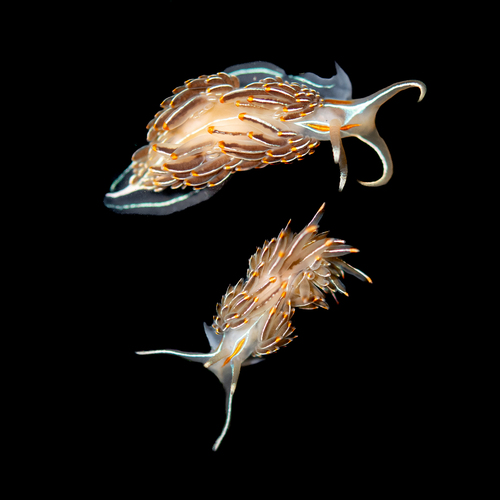
Giant Nudibranch
Dendronotus iris
The Giant Nudibranch is a colorful sea slug that looks like a little underwater rainbow! It glides through the ocean, eating tiny creatures and showing off its beautiful colors.
Habitat: Coastal areas
The Giant Nudibranch has a large, elongated body, typically vibrant orange, red, or white. Its most striking feature is the numerous bushy, tree-like cerata (gills) covering its back, which are used for breathing and defense. It stands out with its frilly oral veil.
Category
InvertebrateRarity
Common
Danger
2/5 · Low
Snaps
Be the first to snap!
It breathes using feathery gills on its back, which look like tiny trees!
It can grow as long as a foot, making it one of the largest sea slugs!
It's a sea slug, not an insect, despite its name sometimes causing confusion!
Some scientists call it a 'clown nudibranch' because of its bright colors!
Giant Nudibranch can absorb pigments from its prey, allowing it to camouflage perfectly within its marine environment.
Giant Nudibranch has numerous frilly cerata on its back that deter predators by making it appear larger and less appealing.
Giant Nudibranch can produce unpleasant chemicals in its body, making it an unappetizing meal for most potential predators.
A fierce underwater hunter, it loves to feast on sea anemones.
Urticina piscivora
Consumes whole anemones using its powerful mouth parts.
Metridium farcimen
Slowly grazes on these anemones found in its habitat.

Pycnopodia helianthoides
A primary predator, able to consume large nudibranchs.
Solitary animals live alone for most of their lives, only interacting with others for mating or parental care.
Colorful describes organisms or objects displaying a wide range of bright and distinct colors.
Gliding animals move through the air by launching themselves and maintaining flight with specialized body structures, without flapping wings.
Coastal habitats are dynamic environments located along the interface between land and sea, influenced by tides, waves, and saltwater.

This trait identifies organisms whose diet consists entirely or primarily of animal tissue.

Regenerative organisms possess the ability to regrow lost or damaged body parts, tissues, or organs.

Aquatic habitats encompass environments where organisms live predominantly in water, including oceans, rivers, lakes, and wetlands.

Giant describes organisms or objects of significantly larger size than average for their species or type.

Marine habitats encompass all saltwater environments of the Earth's oceans, supporting an immense diversity of aquatic life.
Danger
2/5 · Low
Never touch sea creatures without asking an adult first, as some can be delicate or harmful.
The easiest way to identify Giant Nudibranch is to use the Snappit nature identifier app.
100-300 mm
300-400 days
A fierce underwater hunter, it loves to feast on sea anemones.
Coastal areas
Ambush
Zoom in to split clusters and explore where this object has been snapped.
Recent snaps will appear here as new observations are added.
Washington, US
You might spot Horned Nudibranch and Madrone Skin Miner.
View guide →
British Columbia, CA
You might spot Harbor Seal, Evergreen Huckleberry, and Alumroots.
View guide →

Washington, US
You might spot Purple Foxglove, Tansy, and Broad-Leaved Sweet Pea.
View guide →
Take the discovery with you
Snap it with Snappit to identify it, learn what makes it special, and add the discovery to your collection.