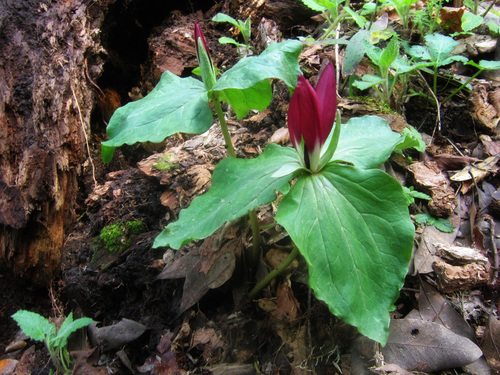


Giant Wakerobin
trillium chloropetalum
The Giant Wakerobin (Trillium chloropetalum) is a stunning, long-lived perennial herb native to the moist forest understories of California and Oregon. Belonging to the Melanthiaceae family, this woodland wonder is famous for its striking three-part structure, featuring a whorl of three large, beautifully mottled leaves topped by a single, stalkless flower. Historically used by Indigenous peoples for various medicinal purposes, this slow-growing plant plays an important role in native ecosystems, offering food for early pollinators and engaging in a unique partnership with forest ants for seed dispersal.
Habitat: Typically found in moist, shaded environments, including mixed evergreen woodlands, redwood forest floors, and damp foothill canyons.
This plant is easily identified by its broad, ovate leaves arranged in a whorl of three, which feature distinctive dark green and purple mottling resembling camouflage. Standing 20 to 60 cm tall, it produces a single, sessile flower that sits directly on the center of the leaves without a stem. The three upright petals vary in color from deep maroon-purple and bronze to delicate pink or greenish-white, enclosing dark purple stamens.
Category
PlantsRarity
Common
Danger
1/5 · Very low
Snaps
Be the first to snap!
It can take up to seven whole years of slow growth for a single seed to develop into a mature, flowering plant.
Its large, stemless flowers emit a sweet, slightly fermented scent reminiscent of red wine to attract native beetles and bees.
The name 'Wakerobin' refers to the plant blooming in early spring, traditionally coinciding with the return of American Robins.
It produces seeds with oil-rich structures called elaiosomes that attract ants, which carry the seeds underground to feed, inadvertently planting them in safe, fertile soil.
By blooming directly on top of its leaf whorl without a stem, it minimizes structural energy cost while keeping flowers highly visible to low-flying insects.
The marbled pattern on its leaves acts as a disguise against herbivores on the dappled forest floor while maximizing light absorption in dim conditions.
As a photosynthetic plant, it generates glucose using sunlight, water, and carbon dioxide, while drawing minerals from the surrounding moist soil.

Aphaenogaster occidentalis
Ants carry the seeds to their underground nests to eat the fleshy elaiosomes, dispersing and planting the seeds.
Odocoileus hemionus
Deer graze heavily on the lush leaves, which can prevent the plant from flowering for several subsequent seasons.
Bombus vosnesenskii
Bumblebees visit the fragrant flowers for pollen and assist the plant in cross-pollination.
No trait badges are assigned for this object yet.
No aliases listed yet.
Collections for this object will appear here as more themes are added.
Danger
1/5 · Very low
No special safety notes yet.
Start with the whole plant, then compare leaf arrangement, leaf edges, stems and any flowers or fruit. Opposite leaves grow in pairs; alternate leaves come one at a time along the stem. These details tell you far more together than a single green leaf does. Plant Identifier: upload a photo and compare the visible details.
20-60 cm
0.05-0.2 kg
15-50 years
As a photosynthetic plant, it generates glucose using sunlight, water, and carbon dioxide, while drawing minerals from the surrounding moist soil.
Typically found in moist, shaded environments, including mixed evergreen woodlands, redwood forest floors, and damp foothill canyons.
Zoom in to split clusters and explore where this object has been snapped.
Recent snaps will appear here as new observations are added.
Take the discovery with you
Snap it with Snappit to identify it, learn what makes it special, and add the discovery to your collection.