
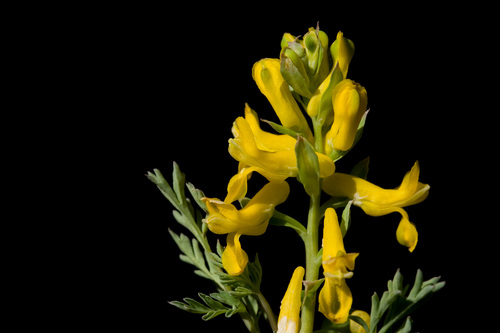


Golden Corydalis
corydalis aurea
Golden Corydalis (Corydalis aurea), also affectionately known as 'Scrambled Eggs,' is a vibrant, low-growing native wildflower of North America. Belonging to the poppy family (Papaveraceae), this resilient plant is known for its cheerful, bright yellow tubular blooms that bring a splash of color to rugged terrains. It behaves as an annual or biennial, quickly colonizing disturbed soils, gravelly slopes, and open woodlands. Beyond its aesthetic appeal, Golden Corydalis plays a crucial role in local ecosystems. It provides an early-season nectar source for native pollinators and shares a fascinating symbiotic relationship with ants, which assist in dispersing its seeds. This hardy little pioneer is a true testament to nature's ability to thrive in challenging, rocky environments.
Habitat: Typically found in sandy, rocky, or gravelly soils, especially in disturbed sites, open pine woodlands, and post-fire zones.
This plant is easily identified by its sprawling, multi-branched form, typically reaching 10 to 40 centimeters in height. Its foliage is highly dissected, fern-like, and pale bluish-green (glaucous) in color. The most striking feature is the dense clusters of tubular, bright golden-yellow flowers, each measuring about 1 to 2 centimeters long. Each flower boasts a distinct spur at the back and a small, darker yellow or orange tip. Following pollination, it produces slender, curved seed pods that dangle from the stems, containing tiny, glossy black seeds.
Category
PlantsRarity
Common
Danger
1/5 · Very low
Snaps
Be the first to snap!
Historically, various Native American tribes utilized the plant in traditional medicine, preparing washes for skin conditions and teas to treat various ailments, despite its toxicity.
The genus name Corydalis comes from the Greek word 'korydalos', meaning crested lark, referencing the lark-like spur on each flower.
The whimsical common name 'Scrambled Eggs' refers to the clustered, messy appearance of the bright yellow, irregularly-shaped flowers.
Its seeds feature an elaiosome, a lipid-rich structure that attracts ants, encouraging them to carry seeds to their nests where they safely germinate.
Produces toxic isoquinoline alkaloids throughout its tissues to deter mammalian herbivores and destructive insect pests.
Adapted to germinate rapidly in nutrient-poor, disturbed, or post-wildfire soils, establishing root systems that help stabilize erosion-prone ground.
Like most plants, Golden Corydalis produces its own energy through photosynthesis, utilizing sunlight, carbon dioxide, water, and soil minerals.

Formica obscuripes
The Western Thatching Ant transports the seeds of Golden Corydalis to its nest to eat the lipid-rich elaiosomes, inadvertently planting the seeds in nutrient-rich soil.
Bombus occidentalis
The Western Bumblebee visits the flowers to harvest nectar, acting as a primary pollinator for the species.

Odocoileus hemionus
May be grazed by Mule Deer, though its alkaloid content usually limits the amount consumed.
No trait badges are assigned for this object yet.
No aliases listed yet.
Collections for this object will appear here as more themes are added.
Danger
1/5 · Very low
No special safety notes yet.
Start with the whole plant, then compare leaf arrangement, leaf edges, stems and any flowers or fruit. Opposite leaves grow in pairs; alternate leaves come one at a time along the stem. These details tell you far more together than a single green leaf does. Plant Identifier: upload a photo and compare the visible details.
10-40 cm
0.01-0.15 kg
1-2 years
Like most plants, Golden Corydalis produces its own energy through photosynthesis, utilizing sunlight, carbon dioxide, water, and soil minerals.
Typically found in sandy, rocky, or gravelly soils, especially in disturbed sites, open pine woodlands, and post-fire zones.
Photosynthesis
Zoom in to split clusters and explore where this object has been snapped.
Recent snaps will appear here as new observations are added.
Take the discovery with you
Snap it with Snappit to identify it, learn what makes it special, and add the discovery to your collection.


















