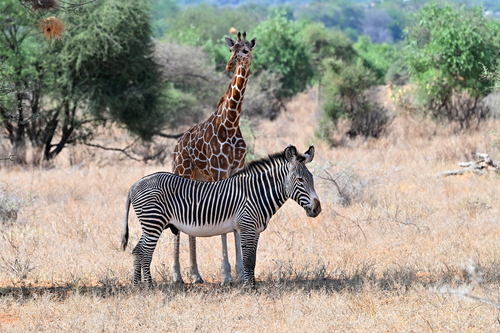


GréVy'S Zebra
equus grevyi
Grévy's Zebra, the largest wild member of the horse family, is an iconic and visually striking mammal native to the semi-arid scrublands of East Africa. Characterized by a majestic stature, a thick, erect mane, and tightly spaced stripes, this species is uniquely adapted to survive in harsh, dry environments. Unlike the more common Plains Zebra, Grévy's Zebras do not form permanent, cohesive herds. Instead, their social structure revolves around solitary, highly territorial males and loose, transient associations of females and their young. What makes the Grévy's Zebra particularly fascinating is its incredible endurance; it can survive for up to five days without water, subsisting on tough, fibrous grasses that other herbivores bypass. Sadly, they are one of Africa's most endangered mammals, facing severe threats from habitat degradation and competition with domestic livestock. Conservation efforts in Kenya and Ethiopia are currently crucial to ensuring this remarkable species continues to roam the African landscape.
Habitat: Found in semi-arid grasslands and dry savannas, often roaming sparsely vegetated plains and thorny scrublands.
Grévy's Zebras are easily distinguished by their very narrow, densely packed black and white stripes, which extend all the way down to their hooves but leave their bellies entirely white. They are noticeably taller and heavier than other zebra species, possessing a thick, prominent dorsal stripe that runs down their spine. Their heads are large and long, featuring a distinct brown muzzle and huge, rounded, mule-like ears that are heavily fringed with hair.
Category
MammalsRarity
Common
Danger
1/5 · Very low
Snaps
Be the first to snap!
Grévy's Zebra foals can stand up within 15 minutes of being born and can run alongside their mothers within just an hour.
It has the longest gestation period of any equid, carrying a foal for approximately 13 months.
Just like human fingerprints, the stripe pattern on every Grévy's Zebra is completely unique, allowing researchers to identify individuals with barcode-scanning software.
The species is named after Jules Grévy, a 19th-century president of France, who received one as a diplomatic gift from the Emperor of Abyssinia (modern-day Ethiopia).
They are highly adapted to semi-desert conditions and can survive up to five days without drinking water by extracting moisture from tough forage.
Stallions claim some of the largest territories of any herbivore—up to 10 square kilometers—which they mark heavily with dung middens and defend fiercely.
Instead of a horse-like whinny, they communicate using deep, resonant grunts and braying sounds that resemble a hippopotamus, which can carry over long distances.
Grévy's Zebras are primarily grazers that consume tough, fibrous grasses, but they will resort to browsing on leaves and bark during severe droughts.
Age differences: Foals rely on their mother's milk for the first six to eight months, though they begin nibbling on grass within a few weeks of birth.

Panthera leo
Preyed upon by large carnivores, particularly when young or weak.
Buphagus erythrorhynchus
Oxpeckers perch on their backs to eat ticks and other parasites in a mutually beneficial relationship.
Bos taurus
Competes heavily for water and grazing resources in arid environments.

Crocuta crocuta
Foals and sometimes adult females are vulnerable to predation by packs of hyenas.
No trait badges are assigned for this object yet.
No aliases listed yet.
Collections for this object will appear here as more themes are added.
Danger
1/5 · Very low
No special safety notes yet.
Compare ears, muzzle, tail, feet and coat markings. Size is hard to judge without something nearby for scale, and young mammals may not have adult coloring yet. Mammal Identifier: upload a photo and compare the visible details.
250-300 cm
350-450 kg
15-22 years
65 km/h
Grévy's Zebras are primarily grazers that consume tough, fibrous grasses, but they will resort to browsing on leaves and bark during severe droughts.
Found in semi-arid grasslands and dry savannas, often roaming sparsely vegetated plains and thorny scrublands.
Grazing
Zoom in to split clusters and explore where this object has been snapped.
Recent snaps will appear here as new observations are added.
Take the discovery with you
Snap it with Snappit to identify it, learn what makes it special, and add the discovery to your collection.