





Great Gray Owl
Strix nebulosa
The Great Gray Owl is a big, beautiful bird with soft gray feathers and bright yellow eyes. It loves to hunt in the dark and can see very well at night, making it a special nighttime friend in the forest.
Habitat: Forests
The Great Gray Owl is a large, imposing owl with a striking, round gray head and no ear tufts. Its distinct facial disc of concentric rings, bright yellow eyes, and a prominent black chin spot (like a bow tie) make it easily recognizable.
Category
BirdsRarity
Common
Danger
2/5 · Low
Snaps
3
Great Gray Owls often use old nests built by other large birds, like hawks.
Their huge fluffy feathers make them look even bigger than they actually are.
They are North America's tallest owl, standing up to 33 inches!
They have a black "bow-tie" mark under their chin that looks quite fancy!
Great Gray Owls can hear tiny prey moving under deep snow, helping them hunt even in winter.
Great Gray Owls have specialized feather edges that allow them to fly almost completely silently, surprising prey.
The Great Gray Owl can rotate its head nearly 270 degrees to scan its surroundings without moving its body.
Great Gray Owls possess powerful talons and strong legs to dive headfirst through crusty snow to catch prey.
These expert hunters primarily feast on small mammals like voles, using their incredible hearing to find prey.
Microtus pennsylvanicus
Primary prey, especially active under snow.
Myodes rutilus
Common prey in dense forest habitats.
Sorex cinereus
Frequent small mammal prey item.
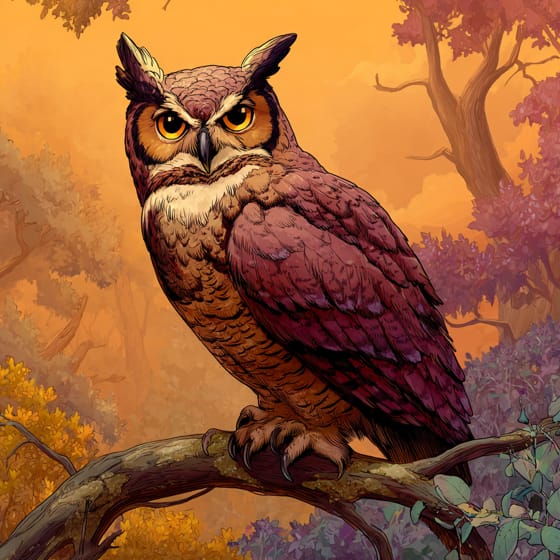
Bubo virginianus
Predates eggs, nestlings, and sometimes adult owls.
Feathered describes animals, primarily birds, possessing a covering of feathers.
Solitary animals live alone for most of their lives, only interacting with others for mating or parental care.
Aerial creatures spend a significant portion of their lives airborne, utilizing flight for various activities such as hunting, migration, or nesting.
An ambush predator hunts by patiently waiting and concealing itself, then launching a sudden attack when unsuspecting prey comes within range.

Forest habitats are terrestrial environments dominated by dense tree cover, supporting a high diversity of plant and animal life.

This trait identifies organisms whose diet consists entirely or primarily of animal tissue.

Describes a species whose presence and role have a disproportionately large effect on its environment.

Nocturnal animals are primarily active during the nighttime hours, typically resting or sleeping during the day.
No aliases listed yet.
Danger
2/5 · Low
If you see an owl, watch quietly from a distance and do not try to touch it.
The easiest way to identify Great Gray Owl is to use the Snappit nature identifier app.
61-84 cm
130-152 cm
0.7-1.8 kg
10-15 years
40 km/h
These expert hunters primarily feast on small mammals like voles, using their incredible hearing to find prey.
Forests
Zoom in to split clusters and explore where this object has been snapped.

Wyoming, US
You might spot Moose, Arrowleaf Balsamroot, and Black Bear.
View guide →

Wyoming, US
You might spot Elk, American Bison, and American White Pelican.
View guide →

Wyoming, US
You might spot Moose, Uinta Ground Squirrel, and Arrowleaf Balsamroot.
View guide →

California, US
You might spot Sequoia, Thimbleberry, and Pacific Dogwood.
View guide →

Wyoming, US
You might spot Moose, Arrowleaf Balsamroot, and Creeping Mahonia.
View guide →

British Columbia, CA
You might spot Salal, Northern Red Belt, and Western Sword Fern.
View guide →
Take the discovery with you
Snap it with Snappit to identify it, learn what makes it special, and add the discovery to your collection.




.jpg&width=800)






