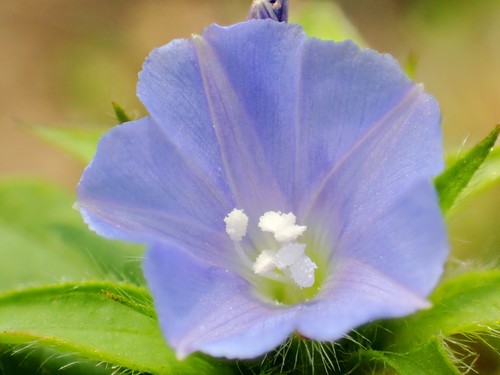


Hairy Cluster-Vine
jacquemontia tamnifolia
The Hairy Cluster-Vine (Jacquemontia tamnifolia) is a charming yet resilient annual vine belonging to the morning glory family, Convolvulaceae. Native to the southeastern United States, Central America, and parts of South America, this plant is famous for its striking, dense clusters of sky-blue to lavender flowers. It thrives in sunny, disturbed habitats, often sprawling across fields, climbing fences, or scaling neighboring plants. While gardeners and nature enthusiasts admire its delicate, funnel-shaped blooms, farmers often view it as a persistent weed because its tough, twining stems can easily entangle agricultural machinery during harvests. Despite its reputation in agriculture, the Hairy Cluster-Vine plays an important ecological role by providing nectar for a variety of native bees, butterflies, and other pollinators during the late summer months.
Habitat: Typically found in disturbed soils, agricultural fields, roadsides, and sandy coastal plains.
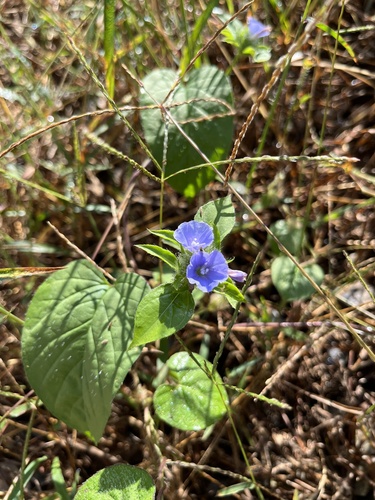
This climbing or sprawling vine is easily recognized by its dense, head-like clusters of tiny, funnel-shaped flowers, which range from a brilliant sky-blue to violet-blue. Each cluster is surrounded by prominent, leaf-like bracts that are heavily covered in soft, spreading brownish-tawny hairs, giving the plant its namesake hairy appearance. The leaves are ovate to heart-shaped, measuring up to 10 cm in length, with pointed tips and smooth margins. The stems themselves are also densely hairy and can grow up to 4 meters long, winding tightly around any available support.
Category
PlantsRarity
Common
Danger
1/5 · Very low
Snaps
2
Despite being in the morning glory family, its flowers open in the morning and typically wilt by mid-afternoon of the same day.
It is considered a major weed in cotton and soybean fields in the southeastern United States because its tough, twining vines can easily tangle harvesting machinery.
Its species name, 'tamnifolia', means 'leaves like Tamnus' (a genus of climbing plants also known as black bryony).
The vine's stems are highly sensitive to contact, allowing them to rapidly coil around vertical structures or neighboring plants to climb toward sunlight.
The dense coating of bristly, tawny hairs on the stems and floral bracts deters crawling insect herbivores and reduces water loss in hot, dry environments.
Flowers open simultaneously in the early morning to capitalize on peak pollinator activity, closing and wilting by afternoon to conserve moisture.
As a photoautotrophic plant, it generates its own energy through photosynthesis, utilizing sunlight, water, and carbon dioxide.
Apis mellifera
Visits the bright blue flowers to forage for nectar and pollen, aiding in pollination.
Bedellia somnulentella
The larvae of this moth mine the leaves of the plant, feeding on the inner tissues.
No trait badges are assigned for this object yet.
No aliases listed yet.
Collections for this object will appear here as more themes are added.
Danger
1/5 · Very low
No special safety notes yet.
The easiest way to identify Hairy Cluster-Vine is to use the Snappit nature identifier app.
100-400 cm
0.1-1 kg
1 years
As a photoautotrophic plant, it generates its own energy through photosynthesis, utilizing sunlight, water, and carbon dioxide.
Typically found in disturbed soils, agricultural fields, roadsides, and sandy coastal plains.
Zoom in to split clusters and explore where this object has been snapped.
Sep 21, 2022
Chambers County Courthouse Square Historic DistrictPhoto attribution
(c) Shelby Lyn Sanders, some rights reserved (CC BY)
License: CC BY 4.0 ↗
Image may be shown cropped inside the card frame.

Alabama, US
You might spot Eastern Box Turtle, Carolina Wren, and Field Sparrow.
View guide →

Louisiana, US
You might spot Rough Horsetail, Northern Mockingbird, and Anole.
View guide →

Alabama, US
You might spot Anole, Bee, and Bristle Thistle.
View guide →

Alabama, US
You might spot Anole, Bee, and Bristle Thistle.
View guide →

Alabama, US
You might spot Anole, Bee, and Bristle Thistle.
View guide →

Alabama, US
You might spot Anole, Bee, and Bristle Thistle.
View guide →
Take the discovery with you
Snap it with Snappit to identify it, learn what makes it special, and add the discovery to your collection.










.jpg&width=800)



_001.jpg&width=800)




