

Hawaiian Beet Webworm Moth
spoladea recurvalis
The Hawaiian Beet Webworm Moth (Spoladea recurvalis) is a widely distributed and visually striking species belonging to the crambid snout moth family. Despite its highly specific common name, this moth is genuinely cosmopolitan, occurring across tropical and subtropical regions worldwide, from Hawaii to Africa, Asia, and the Americas. The species is most renowned for its larval stage, known as the beet webworm, which is a notorious agricultural pest that can defoliate crops like spinach, beets, and amaranth. These industrious caterpillars construct delicate silk webs on the undersides of host leaves, creating tiny sanctuaries from which they feed. While gardeners and farmers might view them as a nuisance, the adult moths are beautiful, delicate creatures. Their bold, contrasting patterns of chocolate brown and crisp white make them easy to identify, adding a touch of elegance to evening gardens as they flutter erratically around porch lights and nectar-rich flowers.
Habitat: Typically found in agricultural fields, vegetable gardens, and weedy grasslands in tropical and subtropical regions where their host plants are abundant.
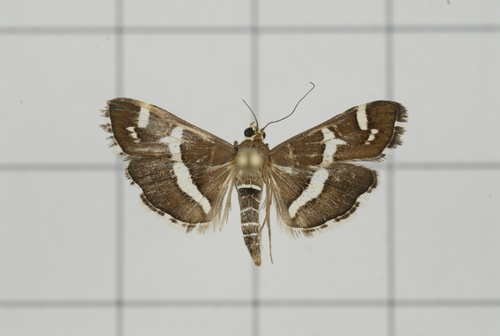
This small but eye-catching moth features a wingspan of roughly 20 to 25 millimeters. Its wings are predominantly rich chocolate brown or blackish-brown, bisected by striking, broad, translucent white bands that run continuously across both the forewings and hindwings when the wings are spread. Additionally, the outer edges of the wings are trimmed with a delicate white fringe. The moth's slender, elongated abdomen is dark but clearly marked with thin, white transverse stripes. When at rest, it typically holds its wings out flat in a distinctive triangular or delta-wing posture, showcasing its vivid geometric patterns.
Category
InsectsRarity
Common
Danger
1/5 · Very low
Snaps
Be the first to snap!
Despite being called the Hawaiian Beet Webworm, this moth is completely cosmopolitan and can be found on nearly every continent.
In ideal tropical conditions, an entire generation of these moths can develop from egg to reproductive adult in less than a month.
The caterpillars are known as webworms because they spin tiny, silken shelters on the undersides of leaves to hide from predators while they eat.
When disturbed, the adult moths take flight in a very erratic, zigzagging pattern before quickly diving back into the vegetation to hide.
Larvae produce fine silk threads to fold or tie leaves together, creating a protective webbing shelter where they can feed safely hidden from predators.
Under optimal warm temperatures, they are capable of completing their entire life cycle from egg to adult in just 30 days, enabling rapid population booms.
When disturbed during the day, adult moths take off in an erratic, zigzagging flight pattern before quickly diving back under foliage to camouflage themselves.
Larvae are voracious leaf-chewing herbivores that target specific plant families, while adult moths feed solely on flower nectar.
Age differences: Larvae consume solid plant tissue such as leaves and stems, whereas adults possess a proboscis adapted for drinking liquid nectar.
Beta vulgaris
Larvae feed extensively on the leaves, making it a primary food source for development.
Amaranthus retroflexus
A common agricultural weed that serves as a wild host for egg-laying and larval feeding.

Tadarida brasiliensis
Hunted by aerial insectivores while the moths fly in search of mates and host plants at night.
No trait badges are assigned for this object yet.
No aliases listed yet.
Collections for this object will appear here as more themes are added.
Danger
1/5 · Very low
No special safety notes yet.
Compare resting wing shape, forewing markings, antennae and body build. Small brown moths can hinge on fine details a phone photo can't always catch. Moth Identifier: upload a photo and compare the visible details.
1-2 cm
2-3 cm
0.0001-0.0003 kg
0-1 years
Larvae are voracious leaf-chewing herbivores that target specific plant families, while adult moths feed solely on flower nectar.
Typically found in agricultural fields, vegetable gardens, and weedy grasslands in tropical and subtropical regions where their host plants are abundant.
Foraging
Zoom in to split clusters and explore where this object has been snapped.
Recent snaps will appear here as new observations are added.
Take the discovery with you
Snap it with Snappit to identify it, learn what makes it special, and add the discovery to your collection.