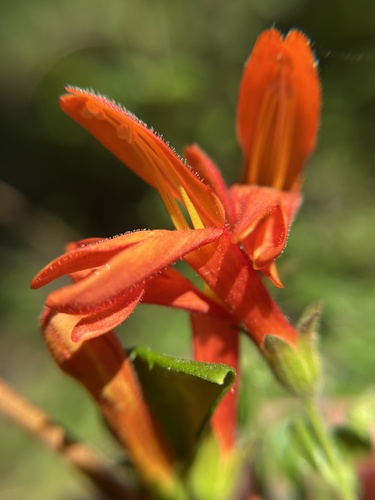


Heartleaf Keckiella
keckiella cordifolia
Heartleaf Keckiella (Keckiella cordifolia) is a beautiful woody perennial shrub native to the arid landscapes of Southern California and Baja California. Its most striking features are its vibrant, tubular flowers and distinct heart-shaped leaves, making it a charismatic member of the chaparral and dry woodland ecosystems. It is a resilient plant, well-adapted to the often harsh, dry conditions of its native habitat, playing an important ecological role by providing nectar for specific pollinators, notably hummingbirds, and offering cover for small wildlife. This species adds a valuable splash of color to the rugged, sun-drenched landscapes where it thrives.
Habitat: Found primarily on dry, rocky slopes, canyon walls, and in chaparral and coastal sage scrub communities, often thriving in well-drained soils.
This shrub generally reaches 30 to 150 centimeters (1 to 5 feet) in height, featuring slender, somewhat woody stems that can be upright or sprawling. The leaves are oppositely arranged along the stem, ovate to distinctly heart-shaped (cordate), and typically a bright to deep green, sometimes with a slightly toothed margin. Its showy flowers are tubular, approximately 2-4 cm long, and appear in attractive clusters from the leaf axils. They are predominantly bright red to reddish-orange, often with subtle yellow streaks or spots in the throat, perfectly adapted in color and shape to attract its primary pollinators.
Category
PlantsRarity
Common
Danger
1/5 · Very low
Snaps
3
Despite its appearance, this species belongs to the plantain family (Plantaginaceae), which includes many familiar but often less showy garden plants and weeds.
Its scientific epithet 'cordifolia' directly translates to 'heart-leaved', referring to the distinctive shape of its foliage.
Like many plants in its chaparral habitat, it has adapted to wildfires and can resprout from a protected woody base after a burn.
The bright red, tubular flowers of Heartleaf Keckiella are a classic example of 'ornithophily', or bird pollination, specifically evolved to attract and reward hummingbirds.
Heartleaf Keckiella possesses a woody stem structure and a deep, extensive root system, allowing it to efficiently access water and survive prolonged periods of drought common in its native arid habitats.
Its bright red, tubular flowers are a classic example of co-evolution with hummingbirds, as their shape and color specifically attract these birds for nectar feeding and pollen transfer.
As a typical chaparral species, it is adapted to periodic wildfires, capable of resprouting vigorously from its woody base (burl) after a fire, or its seeds may be stimulated to germinate by fire.
As a photosynthetic organism, Heartleaf Keckiella produces its own food (sugars) by converting sunlight energy, carbon dioxide from the air, and water into chemical energy. It also absorbs essential mineral nutrients from the soil for growth and maintenance.

Calypte anna
Primary pollinator, attracted to the plant's nectar-rich flowers.
Bombus occidentalis
Potential pollinator, though less specialized than hummingbirds, it visits the flowers for nectar.

Odocoileus hemionus
Herbivore that may browse on the foliage, especially younger shoots.

Eriogonum fasciculatum
A common shrub that grows alongside Heartleaf Keckiella in chaparral, competing for resources.
No trait badges are assigned for this object yet.
No aliases listed yet.
Collections for this object will appear here as more themes are added.
Danger
1/5 · Very low
No special safety notes yet.
Start with the whole plant, then compare leaf arrangement, leaf edges, stems and any flowers or fruit. Opposite leaves grow in pairs; alternate leaves come one at a time along the stem. These details tell you far more together than a single green leaf does. Plant Identifier: upload a photo and compare the visible details.
30-150 cm
5-20 years
As a photosynthetic organism, Heartleaf Keckiella produces its own food (sugars) by converting sunlight energy, carbon dioxide from the air, and water into chemical energy. It also absorbs essential mineral nutrients from the soil for growth and maintenance.
Found primarily on dry, rocky slopes, canyon walls, and in chaparral and coastal sage scrub communities, often thriving in well-drained soils.
Photosynthesis
Zoom in to split clusters and explore where this object has been snapped.

California, US
You might spot Western Fence Lizard and California Brittlebush.
View guide →

California, US
You might spot Western Fence Lizard, Duck, and California Brittlebush.
View guide →

California, US
You might spot Sunburst Anemone, Western Gull, and Giant Coreopsis.
View guide →
Take the discovery with you
Snap it with Snappit to identify it, learn what makes it special, and add the discovery to your collection.