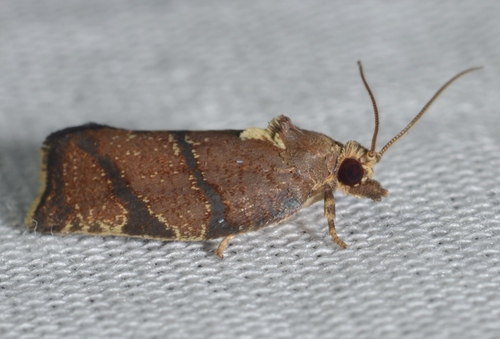


Hickory Leafroller Moth
argyrotaenia juglandana
The Hickory Leafroller Moth (Argyrotaenia juglandana) is a small, fascinating insect belonging to the Tortricidae family, a group widely known as the 'tortrix' or leafroller moths. As its common name suggests, this moth is most famous for its intricate larval stage, where the caterpillar uses strong silk threads to roll or fold the leaves of hickory and walnut trees into protective tubes. These tiny silken fortresses provide the developing larvae with a safe haven from predators and harsh weather while they feed on the surrounding foliage. Though small and unassuming in its adult form, this species plays a vital role in the complex food webs of North American deciduous forests, serving as a food source for birds, bats, and predatory insects. Its life cycle is a brilliant showcase of adaptation, turning the very food it eats into a cleverly engineered shelter.
Habitat: Found primarily in temperate deciduous forests, woodlands, and orchards across eastern North America, closely associating with hickory and walnut trees.
Adult Hickory Leafroller Moths are small and cryptically colored to blend perfectly into their forested surroundings, with a typical wingspan of 1 to 2 centimeters. When at rest, they fold their wings flat over their backs, creating a distinctive bell-like or arrowhead shape characteristic of the Tortricidae family. The forewings are generally light brown to grayish-tan, crossed by darker, oblique brown bands or mottled patterns that mimic the texture of tree bark and dead leaves. The caterpillars, which are more frequently encountered by observant nature lovers, are small, slender, and usually pale green or yellowish-green with a slightly darker head capsule, making them well-camouflaged against the green leaves they consume and inhabit.
Category
InsectsRarity
Common
Danger
1/5 · Very low
Snaps
Be the first to snap!
If a predator disturbs a leafroller caterpillar in its silken shelter, it will quickly wriggle backward and drop towards the ground on a single thread of silk to make a quick escape.
The caterpillar's silk actually shrinks as it dries, acting like a tiny, powerful winch to slowly pull the stiff edges of a hickory leaf together.
The scientific species name 'juglandana' is directly derived from the genus 'Juglans', which includes the walnut trees that this moth relies heavily on for food.
When at rest, tortricid moths like the Hickory Leafroller fold their wings in a way that gives them the distinct shape of a bell or a resting arrowhead.
The larvae exude silk threads that shrink as they dry, pulling the edges of a leaf together to create a rolled, protective shelter.
Adults possess bark-like wing patterns that allow them to seamlessly blend into tree trunks and leaf litter, evading visual predators.
Adult females release highly specific chemical pheromones into the air to attract mates across significant distances in dense forests.
During their larval stage, they are entirely herbivorous, feeding on the foliage of trees in the walnut family (Juglandaceae).
Age differences: Larvae aggressively consume solid plant tissue (leaves), while short-lived adults possess reduced mouthparts and primarily rely on energy reserves from the larval stage.
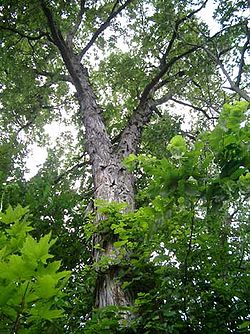
Carya ovata
Host plant providing critical food and structural shelter for larvae.

Juglans nigra
Another major host plant that provides sustenance for caterpillars.

Lasiurus borealis
Insectivorous bats hunt the adult moths out of the air at night.

Poecile atricapillus
Small songbirds forage in the canopy, plucking concealed larvae out of rolled leaves.
No trait badges are assigned for this object yet.
No aliases listed yet.
Collections for this object will appear here as more themes are added.
Danger
1/5 · Very low
No special safety notes yet.
Compare resting wing shape, forewing markings, antennae and body build. Small brown moths can hinge on fine details a phone photo can't always catch. Moth Identifier: upload a photo and compare the visible details.
1-2 cm
1-2 cm
0.00001-0.00005 kg
0-1 years
During their larval stage, they are entirely herbivorous, feeding on the foliage of trees in the walnut family (Juglandaceae).
Found primarily in temperate deciduous forests, woodlands, and orchards across eastern North America, closely associating with hickory and walnut trees.
Foraging
Zoom in to split clusters and explore where this object has been snapped.
Recent snaps will appear here as new observations are added.
Take the discovery with you
Snap it with Snappit to identify it, learn what makes it special, and add the discovery to your collection.