

Hoary Pterocephalus
pterocephalus lasiospermus
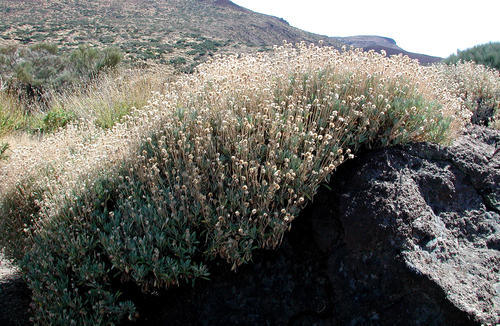
The Hoary Pterocephalus (Pterocephalus lasiospermus), locally known as 'rosalillo de cumbre' in the Canary Islands, is a resilient subalpine shrub endemic to the high-altitude volcanic terrains of Tenerife. Forming dense, silvery-green cushions, this fascinating plant is uniquely adapted to survive the intense sunlight, extreme winds, and freezing temperatures of Mount Teide's subalpine slopes. During the late spring and summer, it bursts into a spectacular display of pale lavender-pink flowers, transforming the austere volcanic landscape into a vibrant sea of pastel color.
Habitat: Found in high-altitude subalpine scrublands and volcanic pumice plains, primarily between 1,800 and 2,600 meters elevation.
This plant grows as a low, rounded shrub usually between 30 and 100 centimeters in height. Its most identifying characteristic is its dense, woolly covering of fine, white-gray hairs on its leaves and stems, giving it a distinct frosted or 'hoary' appearance. The leaves are soft, lance-shaped, and arranged in opposite pairs. In summer, it produces flat-topped, head-like flower clusters (capitula) colored in shades of pale pink to lavender, which eventually turn into fluffy, feathery, globe-shaped seed heads.
Category
PlantsRarity
Common
Danger
1/5 · Very low
Snaps
Be the first to snap!
Because of its high-altitude environment, it acts as a crucial pioneer species, slowly breaking down volcanic minerals to help form fertile soil for other organisms.
It is a master of extreme environments, surviving freezing winter temperatures of down to -10 degrees Celsius and scorching, arid summer days on the active volcano.
The genus name Pterocephalus derives from the Greek words for 'feather' and 'head', referencing the fluffy, feather-like appearance of its seed clusters.
The dense layer of silvery-white hairs reflects harsh high-altitude ultraviolet rays and reduces water loss by trapping moisture close to the leaf surface.
An extensive and deep root system allows the plant to anchor securely in loose, shifting volcanic ash and pumice while tapping into deep-seated moisture.
Its seeds are equipped with a feathery pappus, enabling them to catch alpine wind currents and disperse across rugged volcanic terrains.
As a photosynthetic plant, it synthesizes its own organic compounds using sunlight, carbon dioxide, and water absorbed from volcanic soils.
Bombus canariensis
Provides critical nectar and pollen resources for this endemic bee pollinator during the dry high-altitude summer.

Oryctolagus cuniculus
This introduced herbivore heavily grazes on the young shoots and flowers, threatening its regeneration.
No trait badges are assigned for this object yet.
No aliases listed yet.
Collections for this object will appear here as more themes are added.
Danger
1/5 · Very low
No special safety notes yet.
Start with the whole plant, then compare leaf arrangement, leaf edges, stems and any flowers or fruit. Opposite leaves grow in pairs; alternate leaves come one at a time along the stem. These details tell you far more together than a single green leaf does. Plant Identifier: upload a photo and compare the visible details.
30-100 cm
5-15 years
As a photosynthetic plant, it synthesizes its own organic compounds using sunlight, carbon dioxide, and water absorbed from volcanic soils.
Found in high-altitude subalpine scrublands and volcanic pumice plains, primarily between 1,800 and 2,600 meters elevation.
Zoom in to split clusters and explore where this object has been snapped.
Recent snaps will appear here as new observations are added.
Take the discovery with you
Snap it with Snappit to identify it, learn what makes it special, and add the discovery to your collection.