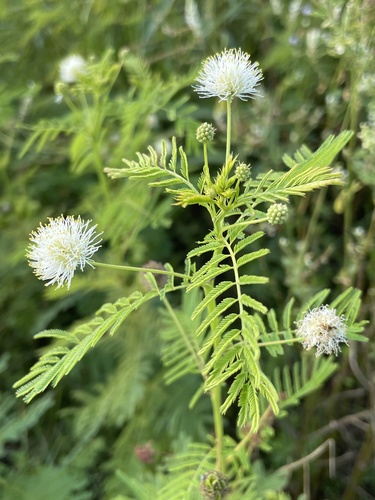


Illinois Bundleflower
desmanthus illinoensis
The Illinois Bundleflower is a deep-rooted, perennial legume native to the prairies, grasslands, and open woodlands of North America, particularly the central United States. Highly valued for its ecological benefits, this plant plays a crucial role in soil health through its symbiotic relationship with nitrogen-fixing bacteria, which enriches the surrounding soil. It is an incredibly resilient plant, adapted to survive droughts and fires thanks to its deep taproot.
Habitat: Typically found in native prairies, open woodlands, glades, riverbanks, and disturbed environments such as roadsides, thriving in moist, well-drained soils.
Growing between 60 to 150 cm tall, this plant features erect, smooth stems adorned with delicate, fern-like bipinnately compound green leaves. In mid-summer, it produces small, fluffy, round white-to-cream flower heads resembling tiny powder-puffs. These flowers develop into highly distinctive, dense, spherical clusters of dark brown, curved, flat seed pods that persist into the winter, giving the plant its 'bundle' name.
Category
PlantsRarity
Common
Danger
1/5 · Very low
Snaps
3
Because the seed pods cluster tightly together in a spherical shape, they visually resemble a small pinecone or a miniature, segmented ball.
Its leaves show 'sleep movements' (nyctinasty), folding closed at night and opening up again in response to daylight.
The plant's seeds are exceptionally rich in protein—containing up to 38% protein, which is comparable to soybeans.
Formulates a symbiotic relationship with subterranean Rhizobium bacteria to convert atmospheric nitrogen into plant-accessible nutrients, enriching the soil.
Folds its delicate, fern-like leaflets together in response to touch, intense midday heat, or darkness to conserve moisture.
Develops a deep, woody taproot that penetrates far into the earth to access water reserves during dry spells.
As a primary producer, the Illinois Bundleflower generates its own energy from sunlight via photosynthesis, drawing water and essential minerals from the soil.

Colinus virginianus
The highly nutritious, protein-rich seeds are a crucial winter food source for Bobwhite Quails.
_female_underside.jpg&width=800)
Phoebis sennae
The foliage serves as a vital host food source for the caterpillars of the Cloudless Sulphur butterfly.
Rhizobium leguminosarum
Root nodules house symbiotic bacteria that capture atmospheric nitrogen for the plant in exchange for carbohydrates.
No trait badges are assigned for this object yet.
No aliases listed yet.
Collections for this object will appear here as more themes are added.
Danger
1/5 · Very low
No special safety notes yet.
The easiest way to identify Illinois Bundleflower is to use the Snappit nature identifier app.
60-150 cm
3-10 years
As a primary producer, the Illinois Bundleflower generates its own energy from sunlight via photosynthesis, drawing water and essential minerals from the soil.
Typically found in native prairies, open woodlands, glades, riverbanks, and disturbed environments such as roadsides, thriving in moist, well-drained soils.
Zoom in to split clusters and explore where this object has been snapped.

Texas, US
You might spot Anole, Monarch, and Pinkladies.
View guide →

Oklahoma, US
You might spot Monarch, American Bumble Bee, and Gulf Fritillary.
View guide →

Missouri, US
You might spot Painted-Cup Paintbrush and Great Spangled Fritillary.
View guide →

Illinois, US
You might spot Illinois Bundleflower, Wild Bergamot, and Cup Plant.
View guide →
Take the discovery with you
Snap it with Snappit to identify it, learn what makes it special, and add the discovery to your collection.











.jpg&width=800)



_001.jpg&width=800)




