





Jaguarundi
Herpailurus yagouaroundi
The Jaguarundi is a sleek, small wild cat that loves to explore! With its long body and short legs, it can run fast and climb trees easily. These cats are often found in warm areas and are very playful.
Habitat: Forests
The Jaguarundi is a sleek, medium-sized wild cat with a long, slender body, short legs, and a small, flattened head. Its coat is uniformly colored, ranging from reddish-brown to dark grey, without any spots or stripes, making it visually distinct from most other small cats.
Category
MammalsRarity
Common
Danger
3/5 · Moderate
Snaps
Be the first to snap!
Jaguarundis are diurnal, meaning they hunt mostly during the day!
Their sleek body and flattened head help them squeeze through dense bushes!
These cats can make more than 13 different sounds, including whistles and chirps!
They use their incredibly long tail like a balancing pole for agility!
Jaguarundi can swim well because of their strong, slender bodies and love for water, which helps them hunt prey near rivers and streams.
Jaguarundi can climb trees skillfully using their sharp claws and muscular legs, which helps them escape predators and find arboreal prey.
Jaguarundi has a wide range of vocalizations, including whistles and chirps, that help them communicate with other jaguarundis.
Jaguarundi can stalk prey silently because of their keen senses and flexible body, which helps them ambush unsuspecting small animals.
These small but mighty hunters feast on rodents, birds, reptiles, and sometimes even fruit!
Sigmodon hispidus
A main food source in many habitats.

Columbina inca
Often preys on ground-dwelling birds.
Anolis carolinensis
Lizards are a frequent part of its diet.
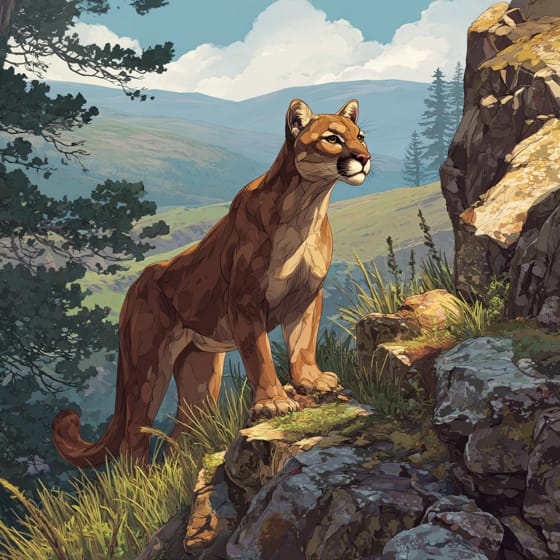
Puma concolor
Larger felids prey on smaller cats.
Furry describes animals possessing a dense covering of soft hair or fur.
Marked with spots or patches of a different color.
Solitary animals live alone for most of their lives, only interacting with others for mating or parental care.
Arboreal animals live primarily in trees, utilizing them for shelter, food, and protection from predators.

Colorful describes organisms or objects displaying a wide range of bright and distinct colors.

Forest habitats are terrestrial environments dominated by dense tree cover, supporting a high diversity of plant and animal life.

This trait identifies organisms whose diet consists entirely or primarily of animal tissue.

This trait identifies organisms that exhibit exceptional swiftness in movement for hunting, escape, or travel.

Endangered status indicates a species is at a very high risk of extinction in the wild in the near future.
Danger
3/5 · Moderate
Jaguarundis are wild animals, so it's best to watch them from a safe distance.
The easiest way to identify Jaguarundi is to use the Snappit nature identifier app.
50-83 cm
3.5-9.1 kg
8-15 years
45 km/h
These small but mighty hunters feast on rodents, birds, reptiles, and sometimes even fruit!
Forests
Ambush
Zoom in to split clusters and explore where this object has been snapped.
Recent snaps will appear here as new observations are added.
Take the discovery with you
Snap it with Snappit to identify it, learn what makes it special, and add the discovery to your collection.




.jpg&width=800)


.JPG&width=800)



.jpg&width=800)
