





Japanese stiltgrass
Microstegium vimineum
Japanese stiltgrass is a soft, green plant that grows tall and can spread quickly. It likes to grow in shady places and can be found in many parks and gardens.
Habitat: Urban areas
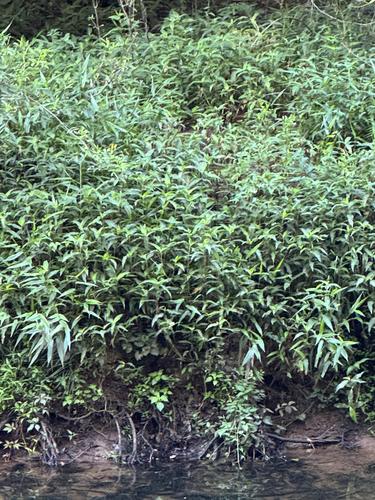
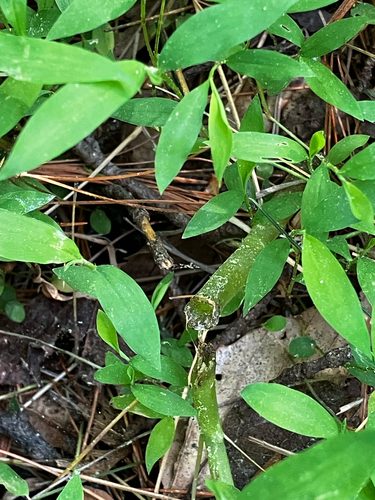
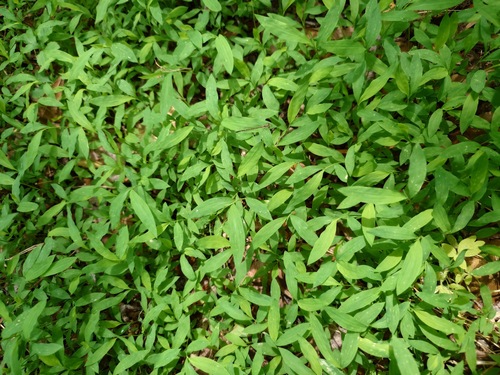
The Japanese stiltgrass has slender, pale green leaves with a distinctive silvery-white stripe down the middle. Its stems are often reddish-purple near the base, forming dense, sprawling mats that can carpet the ground.
Category
PlantsRarity
Common
Danger
1/5 · Very low
Snaps
25
Each plant can produce hundreds of sticky seeds that hitchhike on shoes and fur!
It got its name because its stem props itself up like tiny stilts!
Japanese stiltgrass can completely cover a forest floor, blocking out sunlight!
This grass loves shady spots and can grow where other plants struggle!
Japanese stiltgrass can grow incredibly fast and spread quickly using roots and seeds, helping it take over new areas.
It has special adaptations to thrive in low light, letting it grow densely where many other plants can't survive.
Its tiny, sticky seeds can cling to animals and shoes, allowing it to travel far and wide to new habitats.

Odocoileus virginianus
Browses young shoots, though it's not a preferred food source.
Microtus pennsylvanicus
Eats seeds and blades, especially during colder months.
Myrmica rubra
Ants disperse its sticky seeds, helping the plant spread rapidly.
Aphaenogaster picea
This native ant also helps disperse its seeds via elaiosomes.
Deciduous plants periodically shed all their leaves, typically during autumn or dry seasons.
Flowering plants are any plants that produce flowers as part of their reproductive cycle.
Grass-like plants are herbaceous plants that visually resemble true grasses, typically having long, narrow leaves.
Shade tolerant plants are adapted to grow and thrive in areas with low light levels, requiring less direct sunlight.

Rapid growing plants exhibit accelerated growth rates, quickly increasing in size and biomass within a short period.

This habitat trait indicates species that can coexist with humans in urban and suburban environments, utilizing man-made structures and green spaces.

Invasive species are non-native organisms that cause harm to the environment, economy, or human health.
No aliases listed yet.
Danger
1/5 · Very low
It's safe to touch, but don't eat any plants unless an adult says it's okay.
The easiest way to identify Japanese stiltgrass is to use the Snappit nature identifier app.
30-90 cm
30-100 cm
0.1-0.3 cm
Late summer to fall
No
None
Annual
Zoom in to split clusters and explore where this object has been snapped.
Jun 15, 2026
Columbia Historic District IPhoto attribution
no rights reserved
License: CC0 1.0 ↗
Image may be shown cropped inside the card frame.
Jun 2, 2026
Central Village Historic DistrictPhoto attribution
(c) Bryan Connolly, some rights reserved (CC BY)
License: CC BY 4.0 ↗
Image may be shown cropped inside the card frame.
Apr 27, 2026
FruitvalePhoto attribution
(c) geotrope, some rights reserved (CC BY-SA)
License: CC BY-SA 4.0 ↗
Image may be shown cropped inside the card frame.

Virginia, US
You might spot Eastern Box Turtle and White-Tailed Deer.
View guide →

Alabama, US
You might spot Anole, Eastern Gray Squirrel, and Asian Lady Beetle.
View guide →

South Carolina, US
You might spot Anole, Asian Lady Beetle, and Gulf Fritillary.
View guide →

Alabama, US
You might spot Anole, Eastern Gray Squirrel, and Asian Lady Beetle.
View guide →

Alabama, US
You might spot Anole, Eastern Gray Squirrel, and Asian Lady Beetle.
View guide →

Virginia, US
You might spot Kiwi Bubbles and Eastern Skunk Cabbage.
View guide →
Take the discovery with you
Snap it with Snappit to identify it, learn what makes it special, and add the discovery to your collection.







.jpg&width=800)


_001.jpg&width=800)



