

Jetbead
rhodotypos scandens
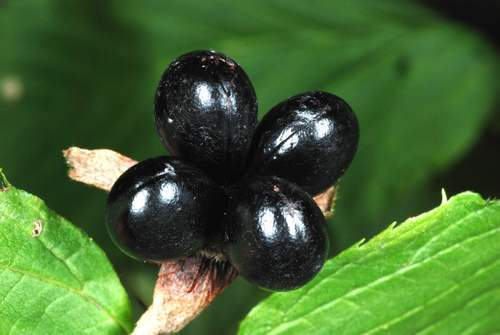
Jetbead (Rhodotypos scandens) is an elegant deciduous shrub native to East Asia, known for its delicate white blossoms and striking jet-black fruits. While it belongs to the rose family (Rosaceae), it stands out due to its unusual pairing of opposite leaves and four-petaled flowers, breaking the family's typical five-petaled mold. In late spring, the shrub is covered in bright white blooms, which soon give way to clusters of hard, glossy black beads that persist through the winter. This hardiness and year-round visual interest make it a popular choice for ornamental gardens. However, because of its adaptability and self-seeding nature, it has escaped cultivation in eastern North America, establishing itself in forest understories and occasionally competing with native vegetation.
Habitat: Found in open woodlands, forest edges, ravines, and urban waste grounds, thriving in both shaded understories and sun-drenched gardens.
This deciduous shrub typically grows between 100 to 200 centimeters tall with upright, arching branches. It is easily identified by its sharply double-toothed, ovate leaves that grow in opposite pairs along the stem, featuring deeply prominent veins. Its bright white flowers are approximately 3 to 5 centimeters across, uniquely featuring exactly four petals instead of the typical five. Following the flowers, groups of one to four shiny, pea-sized, jet-black drupes develop at the tips of the twigs, remaining highly visible even after the green foliage has fallen in autumn.
Category
PlantsRarity
Common
Danger
1/5 · Very low
Snaps
7
The genus name Rhodotypos is derived from Greek words meaning 'rose type', reflecting its botanical relationship despite its unusual physical differences from typical roses.
The seeds inside the shiny black fruits contain amygdalin, a compound that breaks down into toxic hydrogen cyanide if ingested.
Unlike almost all other genera in the Rosaceae (rose) family, which typically feature flowers with five petals, Jetbead uniquely possesses only four petals.
Unlike most members of the rose family, jetbead possesses opposite leaves, optimizing its canopy structure to capture filtered light in shaded understories.
The shiny black drupes contain hard stone centers that shield the seeds inside from harsh winter weather and light predation, ensuring successful germination.
This shrub can photosynthesize efficiently in deep forest understories, allowing it to colonize dense woodlands where other ornamental plants might fail.
As a photoautotrophic plant, Jetbead produces its own energy using sunlight, carbon dioxide, and water through photosynthesis, supplemented by minerals absorbed from the soil.
Turdus migratorius
The fruits of the jetbead are consumed and the seeds are subsequently dispersed by this bird, aiding in the plant's spread.

Popillia japonica
This invasive insect feeds heavily on the foliage of jetbead, causing skeletonized leaf damage during summer months.

Lindera benzoin
In North American forests, jetbead competes directly with native understory shrubs for sunlight, space, and soil resources.
No trait badges are assigned for this object yet.
No aliases listed yet.
Collections for this object will appear here as more themes are added.
Danger
1/5 · Very low
No special safety notes yet.
Start with the whole plant, then compare leaf arrangement, leaf edges, stems and any flowers or fruit. Opposite leaves grow in pairs; alternate leaves come one at a time along the stem. These details tell you far more together than a single green leaf does. Plant Identifier: upload a photo and compare the visible details.
100-200 cm
10-30 years
As a photoautotrophic plant, Jetbead produces its own energy using sunlight, carbon dioxide, and water through photosynthesis, supplemented by minerals absorbed from the soil.
Found in open woodlands, forest edges, ravines, and urban waste grounds, thriving in both shaded understories and sun-drenched gardens.
Passive Absorption
1-4
Zoom in to split clusters and explore where this object has been snapped.

Connecticut, US
You might spot Downy Woodpecker and Eastern Gray Squirrel.
View guide →

Ohio, US
You might spot Duck, Canada Goose, and Muscovy Duck.
View guide →

Michigan, US
You might spot Prairie Trillium, Large White Trillium, and Wild Geranium.
View guide →

Ohio, US
You might spot Common Eastern Bumble Bee, Rudbeckia, and Bee.
View guide →

New Jersey, US
You might spot Chinese Sumac, Porcelain Berry, and White-Tailed Deer.
View guide →

Maryland, US
You might spot Virginia Bluebells, Virginia Springbeauty, and Red Buckeye.
View guide →
Take the discovery with you
Snap it with Snappit to identify it, learn what makes it special, and add the discovery to your collection.