

KōLea Lau Nui
myrsine lessertiana
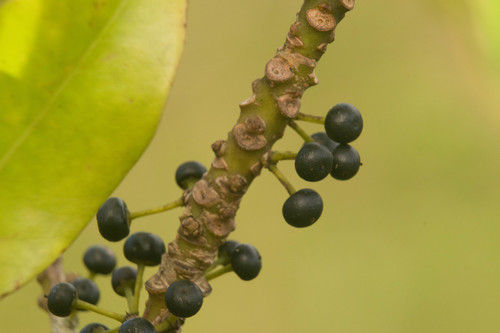
Kōlea lau nui (Myrsine lessertiana) is an impressive and ecologically important tree endemic to the Hawaiian Islands, thriving in the archipelago's mesic and wet forests. Translating to 'large-leafed kōlea' in the Hawaiian language, this resilient species is instantly recognizable by its striking clusters of purplish-black berries that grow directly along its woody stems. Historically, it held immense cultural significance for Native Hawaiians, who utilized its robust timber for constructing house posts and extracted its vivid red sap to dye kapa (barkcloth). Today, it remains a vital component of Hawaii's native forest ecosystems, providing critical shelter and sustenance for endemic bird and insect species. Despite the pervasive threats posed by invasive flora and fauna, the kōlea lau nui continues to stand as a beautiful testament to the unique botanical heritage of Hawaii.
Habitat: Found in mesic to wet montane forests and subalpine shrublands across the major Hawaiian islands, often establishing in well-drained volcanic soils.
This evergreen tree or large shrub typically reaches heights of 3 to 15 meters. It is characterized by its large, thick, and leathery leaves that often display a reddish or purplish tint when young, maturing into a glossy dark green. The bark is relatively smooth and pale, often exuding a distinctive red sap when cut. Kōlea lau nui produces small, inconspicuous yellowish flowers that give way to dense, striking clusters of fleshy, round fruits along the branches just below the leaves. These berries transition from a bright green or pinkish hue to a deep purplish-black as they ripen.
Category
PlantsRarity
Common
Danger
1/5 · Very low
Snaps
Be the first to snap!
Because it produces fruit directly on its woody branches, a botanical trait called cauliflory, it can support heavier crops of berries for native birds to feast upon.
Historically, Native Hawaiians extracted the distinct red sap from its bark to create a vibrant dye for decorating kapa (traditional barkcloth).
Its dense and durable wood was highly valued in ancient Hawaii for constructing sturdy posts in traditional hale (houses).
The Hawaiian name 'Kōlea lau nui' literally translates to 'large-leafed kōlea,' distinguishing it from other closely related native tree species.
It produces flowers and fruits directly along its woody stems and branches, allowing heavier fruit clusters to be supported and easily accessed by foraging birds.
The tree secretes a distinctive pink or red sap when injured, which acts as a defense mechanism against pathogens and was historically utilized as a natural dye.
Its deep root system and sturdy, dense wood allow it to withstand the strong trade winds frequently experienced in Hawaiian montane environments.
As a photoautotroph, it produces its own food through photosynthesis using sunlight, water, and carbon dioxide.
Age differences: Seedlings require partial shade to establish before needing full canopy sunlight to reach maturity.
Myadestes obscurus
Endemic thrushes feed on its fleshy berries and help disperse the seeds across the forest.
Sus scrofa
Invasive feral pigs uproot the soil, destroying seedlings and altering the native forest composition.
Nesophrosyne spp.
Provides a host environment and nutrients for various native Hawaiian insects, such as endemic leafhoppers.
No trait badges are assigned for this object yet.
No aliases listed yet.
Collections for this object will appear here as more themes are added.
Danger
1/5 · Very low
No special safety notes yet.
Start with the whole plant, then compare leaf arrangement, leaf edges, stems and any flowers or fruit. Opposite leaves grow in pairs; alternate leaves come one at a time along the stem. These details tell you far more together than a single green leaf does. Plant Identifier: upload a photo and compare the visible details.
300-1500 cm
50-150 years
As a photoautotroph, it produces its own food through photosynthesis using sunlight, water, and carbon dioxide.
Found in mesic to wet montane forests and subalpine shrublands across the major Hawaiian islands, often establishing in well-drained volcanic soils.
Photosynthesis
Zoom in to split clusters and explore where this object has been snapped.
Recent snaps will appear here as new observations are added.
Take the discovery with you
Snap it with Snappit to identify it, learn what makes it special, and add the discovery to your collection.