

Lancet Clubtail
phanogomphus exilis
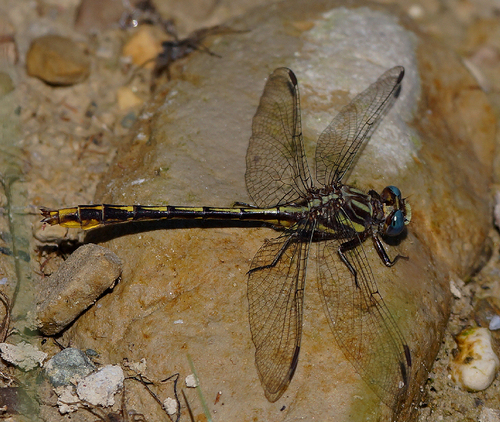
The Lancet Clubtail (Phanogomphus exilis) is a relatively small, early-season dragonfly belonging to the clubtail family (Gomphidae). Known for its striking black and yellow-green coloration, it earns its common name from the lance-shaped yellow markings running down the top of its abdomen. Like many clubtails, it has a habit of perching flat on the ground, rocks, or broad leaves, rather than clinging vertically to stems. It is an agile flyer that patrols calm water bodies during the spring and early summer, capturing smaller insects on the wing. Although its 'club'—the widening at the tip of the abdomen—is less pronounced than in other species of its family, its distinctive markings and widely spaced eyes make it a fascinating find for nature enthusiasts.
Habitat: Found near ponds, lakes, bogs, and slow-moving streams, typically favoring areas with sandy, muddy, or detritus-rich bottoms where their larvae can burrow.
This species is a slender dragonfly typically measuring between 4 to 4.5 centimeters in length. Its thorax is vividly striped with yellowish-green and black, while the abdomen is predominantly black with a series of dorsal yellow spots that resemble the shape of a lancet (a sharp, two-edged surgical instrument) near the tail. Unlike some of its heavier relatives, the widening or 'club' at the end of its abdomen is relatively modest. It features large, widely separated, striking green eyes, a distinguishing trait of the Gomphidae family.
Category
InsectsRarity
Common
Danger
1/5 · Very low
Snaps
1
The 'Lancet' in their name refers to the pointy, dagger-like shape of the yellow markings on the top of their abdomen.
They spend up to 90 percent of their lives underwater as nymphs, only emerging for a brief few weeks to fly, mate, and lay eggs.
Unlike most other dragonfly families whose eyes meet at the top of their head, the eyes of clubtails, including the Lancet Clubtail, are noticeably separated.
Unlike many dragonflies that hang vertically, Lancet Clubtails prefer to land flat on the ground or horizontal surfaces, allowing them to absorb radiant heat.
In their nymph stage, they possess specially adapted legs for burrowing into the sandy or muddy substrates of aquatic environments to camouflage and ambush prey.
Adults are highly agile fliers that calculate intercept trajectories to snatch small flying insects directly out of the air.
As adults, they are voracious aerial predators of smaller flying insects, while their aquatic nymphs ambush various aquatic invertebrates.
Age differences: Nymphs are aquatic ambush predators of water-dwelling invertebrates, whereas adults are aerial hunters of flying insects.
No trait badges are assigned for this object yet.
No aliases listed yet.
Collections for this object will appear here as more themes are added.
Danger
1/5 · Very low
No special safety notes yet.
The easiest way to identify Lancet Clubtail is to use the Snappit nature identifier app.
4-5 cm
5-6 cm
0.0001-0.0005 kg
1-2 years
30 km/h
As adults, they are voracious aerial predators of smaller flying insects, while their aquatic nymphs ambush various aquatic invertebrates.
Found near ponds, lakes, bogs, and slow-moving streams, typically favoring areas with sandy, muddy, or detritus-rich bottoms where their larvae can burrow.
Zoom in to split clusters and explore where this object has been snapped.
Take the discovery with you
Snap it with Snappit to identify it, learn what makes it special, and add the discovery to your collection.



.jpg&width=800)











.jpg&width=800)




