
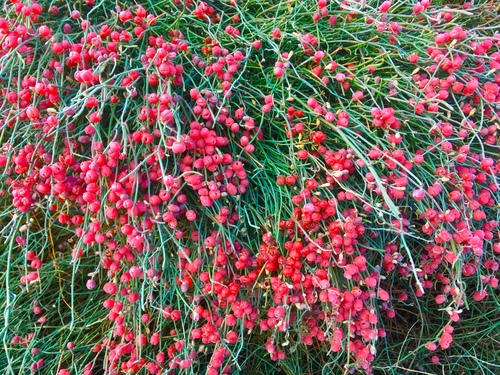


Leafless Ephedra
ephedra foeminea
The Leafless Ephedra (Ephedra foeminea) is a fascinating climbing gymnosperm native to the rugged, rocky landscapes of the eastern Mediterranean. Unlike typical conifers, this sprawling, scrambling shrub resembles a dense tangle of green horsetails or reeds, climbing over cliffs, trees, and neighboring shrubs to reach the sunlight. It belongs to the Gnetophytes, an ancient and evolutionarily unique group of plants that share some traits with flowering plants but are structurally gymnosperms. What makes this species truly extraordinary is its unique pollination method. It has been documented to synchronize the release of glistening, sugary pollination drops with the arrival of the mid-summer full moon, utilizing the bright moonlight to attract nocturnal insect pollinators to its reproductive organs. After successful pollination, female plants produce striking, bright red, berry-like cones that attract birds for seed dispersal.
Habitat: Found on rocky cliffs, limestone outcrops, and coastal scrublands of the eastern Mediterranean region.
This scrambling shrub features long, slender, flexible green stems that perform photosynthesis in place of leaves, which are reduced to tiny, inconspicuous scales at the stem joints. It can grow up to 4 meters in length, draping itself over rocks or other vegetation. During the summer breeding season, female plants are adorned with highly visible, fleshy, egg-shaped cones that turn a vibrant red or orange, measuring about 8-10 mm in diameter, while male plants produce small, yellow-green pollen cones.
Category
PlantsRarity
Common
Danger
1/5 · Very low
Snaps
Be the first to snap!
Despite its name, it does have leaves, but they are reduced to microscopic scales to prevent water loss in hot Mediterranean climates.
It belongs to the Gnetophytes, an ancient division of plants that share some characteristics with flowering plants but are actually gymnosperms.
It is famed for its pollination mechanism, which is synchronized with the full moon of July, a rare example of lunar-driven plant behavior.
Secretes sugary pollination drops that glisten under the light of the July full moon to attract nocturnal insect pollinators.
Performs photosynthesis through its tough, green, reed-like stems to survive in arid environments where traditional leaves would lose too much water.
Utilizes a climbing and scrambling growth habit, allowing it to scale vertical rock faces and other vegetation to optimize solar exposure.
As a photosynthetic plant, the Leafless Ephedra produces its own energy using sunlight, water, and carbon dioxide from the air.
Noctuidae
Nocturnal moths are attracted to the glistening pollination drops under the full moon and pollinate the plant.
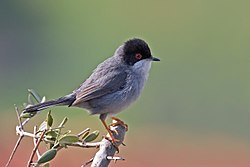
Curruca melanocephala
Birds feed on the bright red, fleshy cones of female plants and disperse the seeds across rocky terrains.
Juniperus phoenicea
Often uses taller shrubs like the Phoenician Juniper as a physical trellis to climb and reach sunlight.
No trait badges are assigned for this object yet.
Collections for this object will appear here as more themes are added.
Danger
1/5 · Very low
No special safety notes yet.
Start with the whole plant, then compare leaf arrangement, leaf edges, stems and any flowers or fruit. Opposite leaves grow in pairs; alternate leaves come one at a time along the stem. These details tell you far more together than a single green leaf does. Plant Identifier: upload a photo and compare the visible details.
100-400 cm
20-100 years
As a photosynthetic plant, the Leafless Ephedra produces its own energy using sunlight, water, and carbon dioxide from the air.
Found on rocky cliffs, limestone outcrops, and coastal scrublands of the eastern Mediterranean region.
Photosynthesis
Zoom in to split clusters and explore where this object has been snapped.
Recent snaps will appear here as new observations are added.
Take the discovery with you
Snap it with Snappit to identify it, learn what makes it special, and add the discovery to your collection.

















