





Linearleaf Phacelia
phacelia linearis
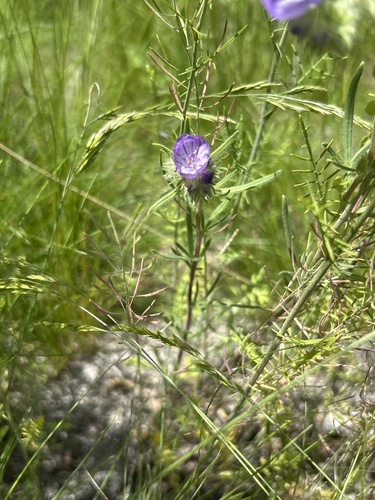
The Linearleaf Phacelia has long, slender leaves that look like little green ribbons! Its beautiful purple flowers attract lots of buzzing bees and fluttering butterflies.
Habitat: Linearleaf Phacelia thrives in sunny fields and open grasslands.
The Linearleaf Phacelia has slender stems and narrow, bright green leaves. Its compact clusters of bell-shaped flowers bloom in shades of lavender to deep purple, sometimes white, making it visually distinct.
Category
PlantsRarity
Common
Danger
0/5 · No known danger
Snaps
3
It's a champion for attracting beneficial insects to gardens, acting like a natural pest control!
Its flower clusters elegantly uncurl like a fern fiddlehead as they bloom!
Some Phacelias are called 'scorpion-weed' because their coiled flower stalk resembles a scorpion's tail!
The name 'Phacelia' comes from a Greek word meaning 'bundle' for its clustered flowers!
Linearleaf Phacelia has tiny, bristly hairs on its leaves and stems that can deter hungry insects from taking a bite.
Linearleaf Phacelia produces sweet nectar that attracts buzzing bees, helping it spread its seeds far and wide.
This plant can bloom early in the spring, giving it a head start on collecting sunshine and attracting pollinators.
Apis mellifera
collects nectar and pollen
Bombus bifarius
visits flowers for nectar
Lasioglossum vierecki
a common native bee pollinator
Colorful describes organisms or objects displaying a wide range of bright and distinct colors.
Grassland habitats are terrestrial biomes dominated by grasses and herbaceous plants, supporting a variety of grazing animals.
This trait characterizes organisms whose diet consists entirely or primarily of plant material.
Diurnal animals are primarily active during daylight hours, typically resting or sleeping at night.

Describes organisms that transfer pollen, enabling the fertilization and reproduction of plants.
Danger
0/5 · No known danger
No special safety notes yet.
The easiest way to identify Linearleaf Phacelia is to use the Snappit nature identifier app.
10-40 cm
10-30 cm
0.5-1.5 cm
Spring_early_summer
No
Mild
Annual
Zoom in to split clusters and explore where this object has been snapped.
Jun 3, 2026
Lake MissoulaPhoto attribution
(c) Taryn Brahmsteadt, some rights reserved (CC BY)
License: CC BY 4.0 ↗
Image may be shown cropped inside the card frame.

Montana, US
You might spot Western Ponderosa Pine and Great Horned Owl.
View guide →

Oregon, US
You might spot Mule Deer, Song Sparrow, and Northern Yellow Warbler.
View guide →

Washington, US
You might spot Eastern Gray Squirrel, Yellow-Bellied Marmot, and Duck.
View guide →

Wyoming, US
You might spot Prairie Dog, Bur Oak, and Rocky Mountains Ponderosa Pine.
View guide →
Take the discovery with you
Snap it with Snappit to identify it, learn what makes it special, and add the discovery to your collection.









.jpg&width=800)



_001.jpg&width=800)




