





Loxodonta cyclotis
Loxodonta cyclotis
The African Forest Elephant is a gentle giant that lives in the forests of Africa. They have big ears and long tusks, and they love to eat leaves and fruits from trees.
Habitat: Forests
The Loxodonta cyclotis is the smallest of the African elephants, with a dark grey hide and pinkish underparts. It has notably rounder ears and straighter, downward-pointing tusks that are often reddish-brown from forest minerals, which helps distinguish it from its savanna relatives.
Category
MammalsRarity
Common
Danger
3/5 · Moderate
Snaps
Be the first to snap!
A forest elephant's stomach can hold as much as 100 liters of water!
Forest elephants help keep the rainforest healthy by spreading seeds far and wide.
Their ivory tusks are so dense they are sometimes called 'diamond ivory'!
They are considered the 'gardeners' of the Congo Basin rainforest.
Loxodonta cyclotis can create vital paths through dense vegetation that other animals use, because of its large size and strength.
Loxodonta cyclotis can dig deep into the earth for water and mineral salts because of its strong tusks, vital in dry seasons.
Loxodonta cyclotis can communicate over long distances using low-frequency rumbling sounds that help them stay connected in thick forests.
Loxodonta cyclotis has a prehensile trunk with two finger-like tips that helps them pick up tiny seeds and berries with precision.
This herbivore munches on a variety of plants, especially ripe fruits, leaves, and bark.
Sclerocarya birrea
eats its fruits, dispersing seeds

Syncerus caffer
uses elephant-created clearings and paths

Gorilla gorilla
travels along paths cleared by elephants
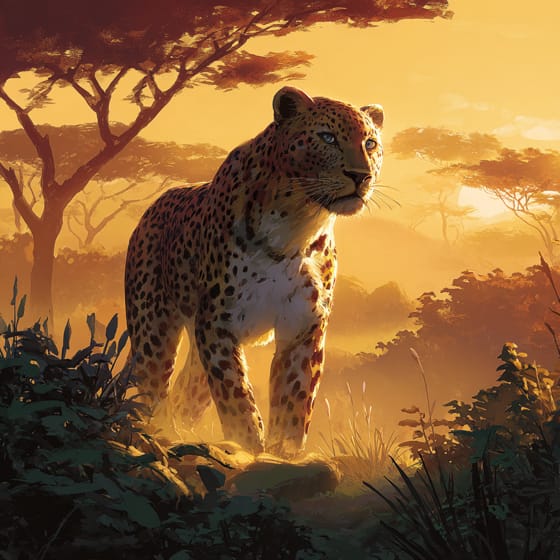
Panthera pardus
occasionally preys on elephant calves
Social animals live in organized groups, cooperating for survival benefits such as foraging, defense, and raising offspring.
This trait characterizes organisms whose diet consists entirely or primarily of plant material.
Characterized by having long, pointed, projecting teeth, usually in pairs.
Forest habitats are terrestrial environments dominated by dense tree cover, supporting a high diversity of plant and animal life.

Diurnal animals are primarily active during daylight hours, typically resting or sleeping at night.

Describes a species whose presence and role have a disproportionately large effect on its environment.

Giant describes organisms or objects of significantly larger size than average for their species or type.

Endangered status indicates a species is at a very high risk of extinction in the wild in the near future.
Danger
3/5 · Moderate
Always admire elephants from a safe distance and never approach them in the wild.
The easiest way to identify Loxodonta cyclotis is to use the Snappit nature identifier app.
160-280 cm
1700-4000 kg
60-70 years
40 km/h
This herbivore munches on a variety of plants, especially ripe fruits, leaves, and bark.
Forests
Foraging
Zoom in to split clusters and explore where this object has been snapped.
Recent snaps will appear here as new observations are added.
Take the discovery with you
Snap it with Snappit to identify it, learn what makes it special, and add the discovery to your collection.




.jpg&width=800)


.JPG&width=800)


.jpg&width=800)
