

MāMane
sophora chrysophylla
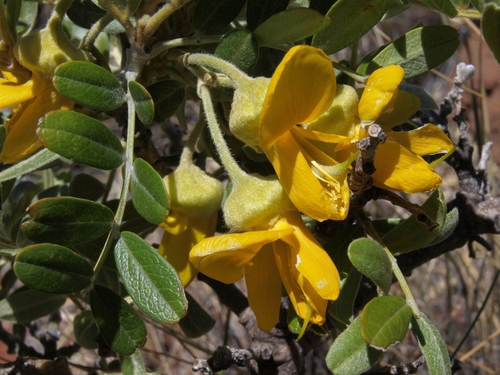
The māmane is a beautiful, hardy woody species endemic to the high-elevation dry forests and shrublands of the Hawaiian Islands, most notably on the slopes of Mauna Kea and Mauna Loa. Belonging to the pea family, this resilient plant plays an irreplaceable role in Hawaii's subalpine ecosystem. It is famous for its vibrant, golden-yellow pea-like flowers that paint the volcanic landscapes with brilliant color, bringing life to otherwise stark environments. Beyond its visual appeal, the māmane is a critical keystone species. It serves as the primary habitat and food source for several endemic Hawaiian forest birds, including the critically endangered palila, which depends almost entirely on the plant's seeds for survival. Historically, its extremely dense, hard wood was highly prized by Native Hawaiians for making tools, house posts, and sled runners, making it a culturally and ecologically invaluable treasure of the archipelago.
Habitat: Found in subalpine dry forests, shrublands, and high-elevation volcanic slopes, particularly on the island of Hawaiʻi between 1,200 and 3,000 meters elevation.
Māmane typically grows as a large shrub or a medium-sized tree, reaching heights of up to 15 meters, though often smaller at high elevations. It is easily identified by its pinnately compound leaves featuring small, oval, grayish-green leaflets that have a fine, velvety texture. During blooming periods, it bursts into clusters of bright, golden-yellow, pea-like flowers hanging from the branches. These flowers develop into distinctive, woody, four-winged seed pods that contain small, hard, bright yellow to orange seeds.
Category
PlantsRarity
Common
Danger
1/5 · Very low
Snaps
1
Māmane wood is so incredibly dense and hard that it was historically used by Native Hawaiians to make spade-like digging tools (ʻōʻō) and sled runners for downhill lava sledding (hōlua).
The gold-colored flowers of the māmane are a major source of nectar for native Hawaiian honeycreepers like the ʻapapane and ʻiʻiwi.
The seeds of the māmane contain high levels of cytisine, a toxic alkaloid that would be lethal to most animals, yet the endemic Palila bird eats them with no ill effects.
Hosts symbiotic rhizobia bacteria in root nodules to convert atmospheric nitrogen into nutrients, allowing growth in barren volcanic soils.
Accumulates toxic alkaloids, particularly cytisine, in its seeds and leaves to deter generalist herbivores and seed predators.
Possesses small, hairy, leathery leaves that minimize water loss in dry, high-altitude subalpine environments.
As an autotrophic plant, the māmane produces its own organic compounds through photosynthesis, using sunlight, water, carbon dioxide, and soil minerals.
Loxioides bailleui
The critically endangered palila bird feeds almost exclusively on the toxic seeds of the māmane.
Ovis aries
Invasive sheep consume young seedlings and strip bark, severely threatening wild māmane populations.
Himatione sanguinea
The endemic Hawaiian honeycreeper feeds on the nectar of māmane flowers, aiding in pollination.
No trait badges are assigned for this object yet.
No aliases listed yet.
Collections for this object will appear here as more themes are added.
Danger
1/5 · Very low
No special safety notes yet.
Start with the whole plant, then compare leaf arrangement, leaf edges, stems and any flowers or fruit. Opposite leaves grow in pairs; alternate leaves come one at a time along the stem. These details tell you far more together than a single green leaf does. Plant Identifier: upload a photo and compare the visible details.
200-1500 cm
50-150 years
As an autotrophic plant, the māmane produces its own organic compounds through photosynthesis, using sunlight, water, carbon dioxide, and soil minerals.
Found in subalpine dry forests, shrublands, and high-elevation volcanic slopes, particularly on the island of Hawaiʻi between 1,200 and 3,000 meters elevation.
Photosynthesis
14-60 days
Zoom in to split clusters and explore where this object has been snapped.

Hawaii, US
You might spot ʻōhiʻa Lehua and Stinking Passionflower.
View guide →

Hawaii, US
You might spot 'āhinahina, Kūpaoa, and Chukar.
View guide →

Hawaii, US
You might spot Māmane, Great Mullein, and Wand Mullein.
View guide →
Take the discovery with you
Snap it with Snappit to identify it, learn what makes it special, and add the discovery to your collection.