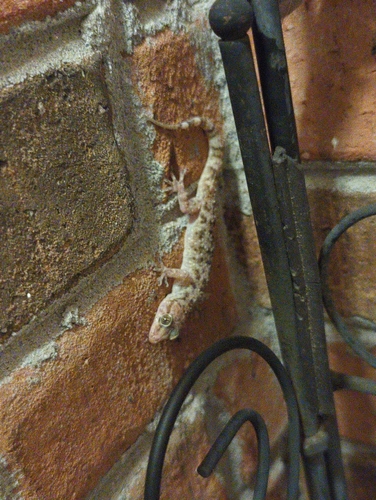

Mediterranean House Gecko
Hemidactylus turcicus
The Mediterranean House Gecko is a small lizard that loves to live near people. They have soft, scaly skin and can change color a little to blend in with their surroundings.
Habitat: Urban areas
The Mediterranean House Gecko has translucent, bumpy skin, often mottled in shades of gray, tan, or pinkish-brown, allowing it to blend into its surroundings. It possesses large, lidless eyes with vertical pupils and sticky toe pads, making it distinct from many other small lizards.
Category
ReptilesRarity
Common
Danger
1/5 · Very low
Snaps
24
Female geckos often lay their eggs in communal spots, sharing safe nurseries for their babies!
These geckos clean their lidless eyes by licking them with their tongue – imagine that!
They can sometimes change their skin color slightly to become a super camouflage master!
You can sometimes see their internal organs through their almost transparent skin!
Mediterranean House Geckos can climb smooth walls and ceilings because of microscopic hairs on their toe pads that provide incredible grip.
Mediterranean House Geckos can detach their tail if caught, which wiggles to distract predators while they run to safety.
Mediterranean House Geckos have huge, lidless eyes with vertical pupils that help them see very well and hunt bugs in the dark.
Mediterranean House Geckos make soft clicking or chirping sounds to talk to each other, especially to defend their territory.
Tiny hunters, they feast on insects and other small invertebrates to stay strong.

Felis catus
Common predator in human-modified environments.
Blattella germanica
A common household pest and food source.
Aedes aegypti
Helps control mosquito populations in homes.
Thamnophis sirtalis
Some native snakes may prey on geckos.
Solitary animals live alone for most of their lives, only interacting with others for mating or parental care.
Camouflaged describes organisms that possess coloring or patterns that allow them to blend into their environment.
This trait identifies organisms whose diet primarily consists of insects and other small invertebrates.
Regenerative organisms possess the ability to regrow lost or damaged body parts, tissues, or organs.

This habitat trait indicates species that can coexist with humans in urban and suburban environments, utilizing man-made structures and green spaces.

Nocturnal animals are primarily active during the nighttime hours, typically resting or sleeping during the day.
Danger
1/5 · Very low
Don't try to catch geckos; they are best left in their homes.
The easiest way to identify Mediterranean House Gecko is to use the Snappit nature identifier app.
10-15 cm
0.003-0.012 kg
5-10 years
8 km/h
Tiny hunters, they feast on insects and other small invertebrates to stay strong.
Urban areas
Ambush
Zoom in to split clusters and explore where this object has been snapped.
May 14, 2026
Daniel Pratt Historic DistrictPhoto attribution
(c) guet567, some rights reserved (CC BY)
License: CC BY 4.0 ↗
Image may be shown cropped inside the card frame.

Alabama, US
You might spot Anole, Eastern Gray Squirrel, and Asian Lady Beetle.
View guide →

South Carolina, US
You might spot Brown Pelican, Boat-Tailed Grackle, and Great Egret.
View guide →

Alabama, US
You might spot Anole, Eastern Gray Squirrel, and Asian Lady Beetle.
View guide →

US
You might spot Brown Pelican, Boat-Tailed Grackle, and Great Egret.
View guide →

Alabama, US
You might spot Anole, Eastern Gray Squirrel, and Asian Lady Beetle.
View guide →

Georgia, US
You might spot Anole, Pond Slider, and Spanish Moss.
View guide →
Take the discovery with you
Snap it with Snappit to identify it, learn what makes it special, and add the discovery to your collection.