

Montpellier Cistus
cistus monspeliensis
Montpellier Cistus (Cistus monspeliensis) is a hardy, evergreen shrub native to the Mediterranean Basin. It is a quintessential component of the 'maquis' and 'garigue' shrublands, renowned for its ability to thrive in poor, rocky soils and survive intense summer droughts. This resilient plant is famously fire-adapted, utilizing the heat of wildfires to crack open its seed coats and regenerate rapidly, ensuring its dominance in post-fire landscapes. Its resinous foliage releases a distinct, pleasant balsam aroma that is characteristic of the Mediterranean hillsides.
Habitat: Typically found in Mediterranean-type ecosystems, particularly in dry, rocky open shrublands, garigues, and degraded pine forests on acidic soils.
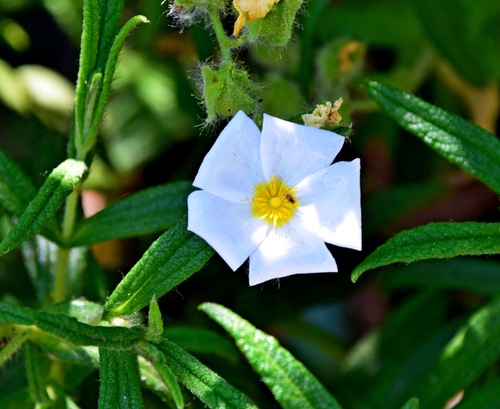
This dense, mounding shrub typically grows to a height of 60 to 120 cm. It is easily identified by its sticky, linear, dark green leaves that are rough to the touch, opposite, and emit a strong balsamic fragrance when crushed. In late spring, the plant produces abundant clusters of small, five-petaled white flowers, each about 2 to 3 cm in diameter, featuring a bright yellow center of dense stamens. The seed capsules that follow are small, woody, and split into five valves.
Category
PlantsRarity
Common
Danger
1/5 · Very low
Snaps
Be the first to snap!
In ancient times, goats were driven through Cistus shrubs so that the valuable ladanum resin would stick to their coats and beard hair, making it easy for herders to collect.
Montpellier Cistus is highly flammable due to its volatile resins, which actually helps fuel wildfires that eliminate competing vegetation and trigger its own seed germination.
The sticky resin produced by its leaves, known as ladanum, has been harvested since ancient times and is used as a fixative in the perfume industry.
Its seeds possess extremely hard coats that remain dormant in the soil for years, relying on the intense heat of a wildfire to trigger germination.
The leaves secrete a sticky, highly aromatic resin called ladanum, which minimizes water loss during dry summers and deters grazing animals.
It employs a deep root system and can shed a portion of its leaves during extreme drought to conserve moisture.
As a photosynthetic plant, it generates its own energy from sunlight, water, and carbon dioxide, while absorbing essential minerals through its root system.
Cytinus hypocistis
The parasitic plant Cytinus hypocistis grows directly on the roots of Cistus monspeliensis, drawing nutrients and water from its host.

Apis mellifera
Western honeybees frequently visit the abundant white flowers for pollen, assisting in cross-pollination.
No trait badges are assigned for this object yet.
No aliases listed yet.
Collections for this object will appear here as more themes are added.
Danger
1/5 · Very low
No special safety notes yet.
Start with the whole plant, then compare leaf arrangement, leaf edges, stems and any flowers or fruit. Opposite leaves grow in pairs; alternate leaves come one at a time along the stem. These details tell you far more together than a single green leaf does. Plant Identifier: upload a photo and compare the visible details.
60-120 cm
10-25 years
As a photosynthetic plant, it generates its own energy from sunlight, water, and carbon dioxide, while absorbing essential minerals through its root system.
Typically found in Mediterranean-type ecosystems, particularly in dry, rocky open shrublands, garigues, and degraded pine forests on acidic soils.
Zoom in to split clusters and explore where this object has been snapped.
Recent snaps will appear here as new observations are added.
Take the discovery with you
Snap it with Snappit to identify it, learn what makes it special, and add the discovery to your collection.