.jpg&width=800)





Atlantic Sand Fiddler Crab
leptuca pugilator
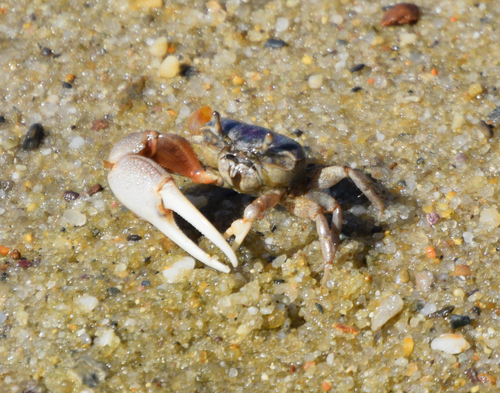
The Atlantic Sand Fiddler Crab is a tiny crab that loves to dance on the beach! Watch out for its big claw, which it waves around to attract friends!
Habitat: They live in sandy beaches and coastal areas along the Atlantic Ocean.
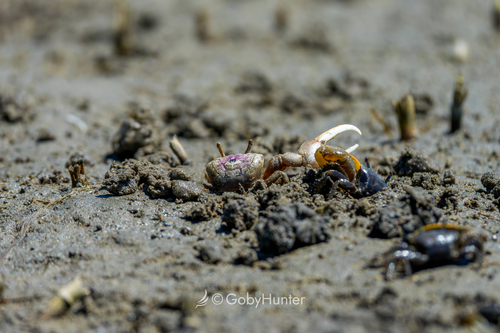
The Atlantic Sand Fiddler Crab has a square-shaped body, typically tan to greenish-brown, with stalked eyes. Males possess one enormous, brightly colored claw, often white, yellow, or orange, significantly larger than the other smaller claw and the female's two small claws.
Category
InvertebrateRarity
Common
Danger
0/5 · No known danger
Snaps
12
Fiddler crabs can hold their breath for a very long time when hiding in their burrows.
Males wave their giant claw not just for show, but also to release extra body heat!
Their stalked eyes give them a super wide view, like having built-in binoculars.
Wow! If a male loses its huge claw, the other tiny claw quickly grows into a new big one!
Atlantic Sand Fiddler Crab males have one huge claw that helps them attract mates and defend their burrows from rivals.
Atlantic Sand Fiddler Crab can change its carapace color to match the sand, helping them hide from predators.
Atlantic Sand Fiddler Crab can rapidly dig complex burrows in the sand because of strong legs, which provide shelter and safety.
They filter tiny food particles like algae and detritus from the sand and mud.
Social animals live in organized groups, cooperating for survival benefits such as foraging, defense, and raising offspring.
Burrowing animals dig tunnels and chambers in the ground, using these subterranean structures for shelter, hunting, or breeding.
This trait identifies organisms whose diet consists entirely or primarily of animal tissue.
Diurnal animals are primarily active during daylight hours, typically resting or sleeping at night.

Marine habitats encompass all saltwater environments of the Earth's oceans, supporting an immense diversity of aquatic life.
Danger
0/5 · No known danger
No special safety notes yet.
The easiest way to identify Atlantic Sand Fiddler Crab is to use the Snappit nature identifier app.
2.5 cm
4 cm
5 g
3 years
They filter tiny food particles like algae and detritus from the sand and mud.
They live in sandy beaches and coastal areas along the Atlantic Ocean.
Foraging
Zoom in to split clusters and explore where this object has been snapped.
Jun 13, 2026
Wellfleet Bay Wildlife SanctuaryPhoto attribution
(c) Natasha Haggard, some rights reserved (CC BY)
License: CC BY 4.0 ↗
Image may be shown cropped inside the card frame.
Jun 2, 2026
Stone Harbor Bird SanctuaryPhoto attribution
(c) GobyHunter, some rights reserved (CC BY)
License: CC BY 4.0 ↗
Image may be shown cropped inside the card frame.

US
You might spot Firewheel, Domestic Horse, and Atlantic Horseshoe Crab.
View guide →
Massachusetts, US
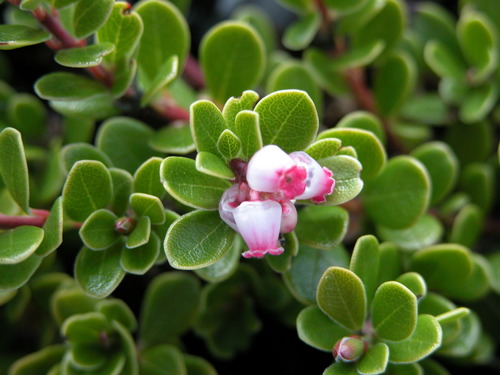
You might spot Bearberry, Mud Fiddler Crab, and Pitch Pine.
View guide →

New Jersey, US
You might spot Common Loon, Laughing Gull, and Ring-Billed Gull.
View guide →
US
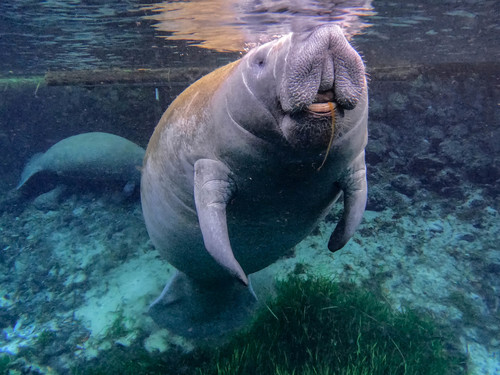
You might spot West Indian Manatee, Scarlet Skimmer, and Queen.
View guide →
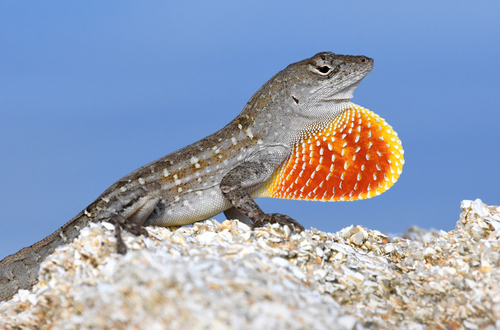
Florida, US
You might spot Brown Anole, Sanderling, and Great Southern White.
View guide →

Florida, US
You might spot Gopher Tortoise, Brown Anole, and Coontie.
View guide →
Take the discovery with you
Snap it with Snappit to identify it, learn what makes it special, and add the discovery to your collection.