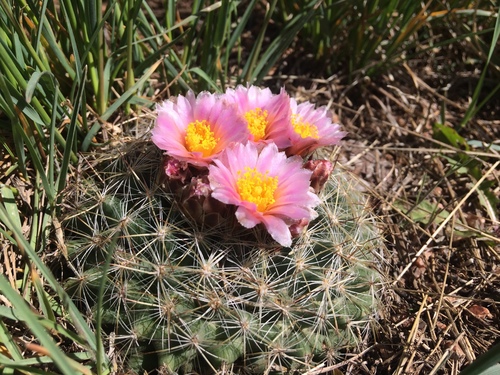


Mountain Ball Cactus
pediocactus simpsonii
The Mountain Ball Cactus (Pediocactus simpsonii) is a hardy and charming succulent native to the high-elevation regions of western North America. Residing at altitudes of up to 10,000 feet, this resilient little plant is famous for its incredible cold tolerance, braving freezing winter temperatures that would easily kill most other cacti. Growing as a solitary or small-clumped sphere, it acts as a vital component of the alpine and subalpine ecosystems it calls home. During the late spring and early summer, the Mountain Ball Cactus transforms from an unassuming, spiky mound into a breathtaking display of color. It produces a crown of delicate pink, yellow, or white blossoms at its apex, attracting native bumblebees and other pollinators. Because of its adaptability and compact size, it has earned a special place in the hearts of desert-plant enthusiasts and hikers alike, who delight in spotting its vibrant blooms against the rugged, rocky terrain.
Habitat: Typically found in rocky, well-drained soils within high-altitude grasslands, sagebrush scrub, and open pine woodlands of the western United States.
This small cactus features a globular to egg-shaped stem that typically measures 3 to 15 centimeters in height and diameter. It is densely covered in clusters of straight, needle-like spines radiating outward, ranging in color from white and yellow to reddish-brown, which almost completely obscure the green flesh underneath. In spring, a tight cluster of bell-shaped flowers emerges from the top center of the plant, showing shades of pink, magenta, white, or pale yellow, which are later replaced by small, dry, green to reddish seed pods.
Category
PlantsRarity
Common
Danger
1/5 · Very low
Snaps
1
During the freezing winter months, the cactus can lose so much water that it shrivels and pulls itself partially flat or even slightly underground to escape freezing alpine winds.
It is one of the most northerly and highest-altitude occurring cacti in North America, thriving at elevations up to 3,000 meters.
The species name 'simpsonii' honors James H. Simpson, a 19th-century US Army engineer who collected specimens during his western expeditions.
To survive sub-zero alpine winters, the cactus expels water from its cells into extracellular spaces, preventing destructive ice crystal formation within its vital tissues.
A dense mesh of overlapping spines acts as natural sunscreen, shading the stem from intense high-altitude ultraviolet radiation and reducing desiccating wind exposure.
It utilizes Crassulacean Acid Metabolism, opening its stomata exclusively at night to absorb carbon dioxide, dramatically reducing daytime water loss in dry climates.
As a photosynthetic plant, the Mountain Ball Cactus produces its own chemical energy from sunlight, carbon dioxide, and water, supplemented by minerals absorbed through its shallow root system.
Bombus huntii
Provides essential nectar and pollen during the spring, relying on the insects for cross-pollination.

Pogonomyrmex occidentalis
Collects the small seeds, feeding on some while dispersing and planting others in nutrient-rich nest debris.
No trait badges are assigned for this object yet.
No aliases listed yet.
Collections for this object will appear here as more themes are added.
Danger
1/5 · Very low
No special safety notes yet.
The easiest way to identify Mountain Ball Cactus is to use the Snappit nature identifier app.
3-15 cm
0.05-0.8 kg
15-50 years
As a photosynthetic plant, the Mountain Ball Cactus produces its own chemical energy from sunlight, carbon dioxide, and water, supplemented by minerals absorbed through its shallow root system.
Typically found in rocky, well-drained soils within high-altitude grasslands, sagebrush scrub, and open pine woodlands of the western United States.
Zoom in to split clusters and explore where this object has been snapped.

Colorado, US
You might spot Common Starlily and Wholeleaf Paintbrush.
View guide →

Colorado, US
You might spot Front Range Beardtongue and Mountain Ball Cactus.
View guide →

Colorado, US
You might spot Elk, Mule Deer, and Black-Billed Magpie.
View guide →

Colorado, US
You might spot Mountain Ball Cactus and Scarlet Gilia.
View guide →
Take the discovery with you
Snap it with Snappit to identify it, learn what makes it special, and add the discovery to your collection.











.jpg&width=800)



_001.jpg&width=800)




