
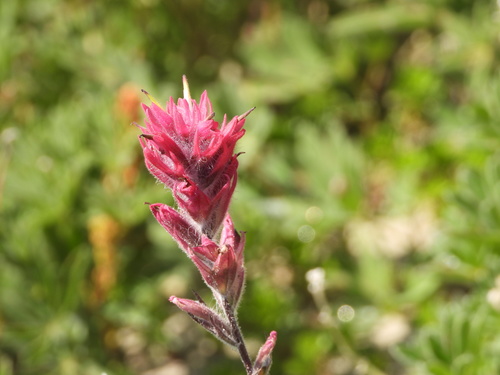


Mountain Paintbrush
castilleja parviflora
The Mountain Paintbrush, also known as the small-flowered paintbrush, is a stunning perennial herb renowned for painting alpine and subalpine meadows with brilliant splashes of color. While it appears to be a typical wildflower, this species possesses a fascinating and crafty secret: it is hemiparasitic. It actively steals nutrients and water from the root systems of neighboring plants while still maintaining its own ability to photosynthesize. This adaptation allows it to thrive in nutrient-poor mountain soils where other plants might struggle.
Habitat: Found in subalpine and alpine meadows, heathlands, and open rocky slopes of western North American mountain ranges.
This herb grows in upright clumps, typically reaching 10 to 40 centimeters in height. Its most striking feature is its dense spike of showy, deeply-lobed bracts, which range in color from a brilliant magenta-pink and rose-red to occasionally creamy white. These colorful bracts look like brush tips dipped in paint and conceal the true flowers, which are small, slender, and green. The leaves of the plant are lance-shaped, alternating, and often divided into narrow lobes near the top.
Category
PlantsRarity
Common
Danger
1/5 · Very low
Snaps
Be the first to snap!
Because they rely on a complex network of host roots to survive, they are incredibly difficult to cultivate in home gardens and rarely survive transplantation.
Indigenous peoples of western North America historically used flowers of Castilleja species as a sweet treat, though some parts of the plant can absorb toxic selenium from the soil.
The brilliant 'flowers' of the paintbrush are actually modified leaves called bracts; the true flowers are small green tubes hidden inside.
It utilizes specialized underground structures called haustoria to tap into the root systems of nearby host plants, extracting water, minerals, and organic compounds.
Modified leafy bracts mimic large, brightly colored petals to attract pollinators like hummingbirds to its inconspicuous true flowers.
It has adapted to survive harsh alpine winters under heavy snowpacks, emerging quickly to bloom during the short mountain summer.
While it produces sugars via its own photosynthesis, it heavily supplements its diet by siphoning water, mineral salts, and nitrogen from host plants.
Age differences: Seedlings initially rely on stored seed energy and independent photosynthesis before establishing haustorial connections with a host plant.
Lupinus latifolius
The Mountain Paintbrush taps into the root systems of this common subalpine legume to steal water and fixed nitrogen.

Selasphorus rufus
An important pollinator attracted to the bright magenta bracts, drinking nectar from the tubular flowers.

Lepus americanus
Feeds on the foliage and flowering stems of the plant during the short alpine growing season.
No trait badges are assigned for this object yet.
No aliases listed yet.
Collections for this object will appear here as more themes are added.
Danger
1/5 · Very low
No special safety notes yet.
Start with the whole plant, then compare leaf arrangement, leaf edges, stems and any flowers or fruit. Opposite leaves grow in pairs; alternate leaves come one at a time along the stem. These details tell you far more together than a single green leaf does. Plant Identifier: upload a photo and compare the visible details.
10-40 cm
0.02-0.15 kg
3-10 years
While it produces sugars via its own photosynthesis, it heavily supplements its diet by siphoning water, mineral salts, and nitrogen from host plants.
Found in subalpine and alpine meadows, heathlands, and open rocky slopes of western North American mountain ranges.
Foraging
Zoom in to split clusters and explore where this object has been snapped.
Recent snaps will appear here as new observations are added.

Washington, US
You might spot Cascade Golden-Mantled Ground Squirrel.
View guide →

Washington, US
You might spot White Pasqueflower, Pearly Everlasting, and Avalanche Lily.
View guide →

Washington, US
You might spot Cascade Golden-Mantled Ground Squirrel.
View guide →
Take the discovery with you
Snap it with Snappit to identify it, learn what makes it special, and add the discovery to your collection.

















