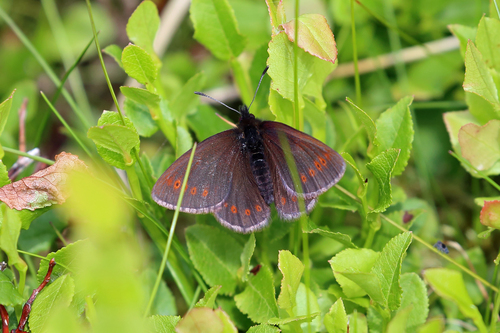


Mountain Ringlet
erebia epiphron
The Mountain Ringlet is a small, elusive butterfly that thrives in the crisp, cool air of high-altitude alpine and subalpine meadows. As one of the few true mountain butterflies, it is uniquely adapted to survive in harsh, windswept environments where few other species can endure. A member of the 'browns' subfamily, it spends the majority of its life as a caterpillar safely tucked into the bases of tough mountain grasses under the winter snow. When summer finally arrives and the snow retreats, the adult butterflies emerge for a brief, frantic flight period, bringing a flutter of dark wings and orange spots to the rugged mountain terrain.
Habitat: Typically found in high-altitude alpine grasslands, damp upland moorlands, and rugged subalpine meadows rich in native tussock grasses.
The Mountain Ringlet is a relatively small butterfly with a wingspan of about 3 to 4 centimeters. Its wings are a deep, velvety dark brown, adorned with a series of reddish-orange bands or patches near the outer edges. Inside these orange patches are small, unpupilled black spots—the distinct 'ringlets' that give the species its name. The underside of the wings is similarly patterned but slightly paler, providing excellent camouflage when the butterfly rests with its wings closed among the alpine rocks and dry grasses.
Category
InsectsRarity
Common
Danger
1/5 · Very low
Snaps
Be the first to snap!
Because the weather at high altitudes can be so poor, adults may only get a few hours of suitable flying conditions during their brief 2 to 3 week lifespan.
Caterpillars are known to hibernate through the long mountain winters, sometimes taking two full years to complete their lifecycle if conditions remain too cold.
The Mountain Ringlet is Britain's only true alpine butterfly, surviving at elevations where no other butterfly species can breed.
The butterfly's dark brown wing coloration allows it to rapidly absorb solar radiation to warm its flight muscles in cold alpine environments.
Adapted to extreme cold, the caterpillars can overwinter multiple times if the mountain summer is too short for them to reach maturity.
Adults fly very close to the ground, utilizing microclimates and avoiding being swept away by strong, unpredictable mountain winds.
The caterpillars feed exclusively on tough alpine grasses, while the adult butterflies opportunistically drink nectar from low-growing mountain flowers.
Age differences: Larvae consume grass leaves, while adults rely entirely on floral nectar for energy.
Nardus stricta
Provides the primary food source for Mountain Ringlet caterpillars.
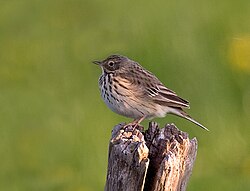
Anthus pratensis
Insectivorous upland birds prey on adult butterflies and caterpillars.
Potentilla erecta
Adult butterflies feed on its nectar and aid in pollination.
No trait badges are assigned for this object yet.
No aliases listed yet.
Collections for this object will appear here as more themes are added.
Danger
1/5 · Very low
No special safety notes yet.
Compare the wing outline, spots, bands, eyespots and wing edges. The underside can look completely different from the top. Check for tails, the antennae and where the markings sit instead of relying on color alone. Butterfly Identifier: upload a photo and compare the visible details.
1-2 cm
3-4 cm
0.0001-0.0003 kg
1-2 years
8 km/h
The caterpillars feed exclusively on tough alpine grasses, while the adult butterflies opportunistically drink nectar from low-growing mountain flowers.
Typically found in high-altitude alpine grasslands, damp upland moorlands, and rugged subalpine meadows rich in native tussock grasses.
Zoom in to split clusters and explore where this object has been snapped.
Recent snaps will appear here as new observations are added.
Take the discovery with you
Snap it with Snappit to identify it, learn what makes it special, and add the discovery to your collection.