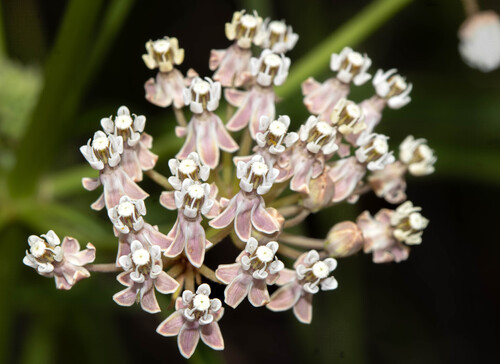


Narrowleaf Milkweed
asclepias fascicularis
Narrowleaf Milkweed (Asclepias fascicularis) is a resilient perennial herb native to the western United States. Highly prized by gardeners and conservationists alike, this plant features slender, lance-shaped leaves and dense, rounded clusters of delicate, star-shaped white-to-lavender flowers. It serves as a vital ecological cornerstone in its native range, supporting a myriad of pollinating insects and acting as a critical host plant for the iconic Monarch butterfly.
Habitat: Typically found in dry, open habitats including valleys, foothills, chaparral, deserts, grasslands, and along roadsides.
This plant typically grows upright to a height of 50 to 100 cm. It is easily distinguished by its exceptionally narrow, linear leaves that grow in tight whorls or opposite pairs along the slender, greenish-purple stems. From late spring to early autumn, the plant produces rounded, umbrella-like clusters of small, 5-petaled flowers which range in color from greenish-white to pale pink or lavender. After pollination, it develops smooth, slender, teardrop-shaped seed pods that eventually split open to release flat, brown seeds attached to silky, white fluff.
Category
PlantsRarity
Common
Danger
1/5 · Very low
Snaps
2
Indigenous peoples historically harvested the strong, fibrous stems of this plant to weave high-quality ropes, nets, and bowstrings.
The plant's milky sap contains toxic cardiac glycosides, which monarch caterpillars safely ingest to make themselves highly unpalatable to birds.
Unlike most flowers that have loose pollen, milkweed packages its pollen into tiny, sticky sacks called pollinia that clip onto the legs of visiting insects.
Synthesizes toxic cardiac glycosides within its milky white sap to deter generalist herbivores from eating its foliage.
Utilizes a deep, extensive taproot system to access water deep within dry, clay-heavy soils during hot summer months.
Produces seeds equipped with silky, lightweight hairs that catch the wind, allowing them to disperse over great distances.
As a photoautotrophic plant, it produces its own sugars through photosynthesis, utilizing sunlight, carbon dioxide, and water while absorbing essential minerals through its root system.

Danaus plexippus
Serves as a critical host plant and food source for Monarch butterfly caterpillars, which sequester the plant's toxins for their own defense.
.jpg&width=800)
Oncopeltus fasciatus
Sucking insects that feed on the seeds, leaves, and stems of the milkweed plant.
Apis mellifera
Visits the flowers for nectar and acts as an efficient pollinator of the plant.
No trait badges are assigned for this object yet.
No aliases listed yet.
Collections for this object will appear here as more themes are added.
Danger
1/5 · Very low
No special safety notes yet.
The easiest way to identify Narrowleaf Milkweed is to use the Snappit nature identifier app.
50-100 cm
3-10 years
As a photoautotrophic plant, it produces its own sugars through photosynthesis, utilizing sunlight, carbon dioxide, and water while absorbing essential minerals through its root system.
Typically found in dry, open habitats including valleys, foothills, chaparral, deserts, grasslands, and along roadsides.
Zoom in to split clusters and explore where this object has been snapped.
California, US
You might spot Warrior's Plume, Western Leatherwood, and White Globe Lily.
View guide →

California, US
You might spot Western Fence Lizard and Springtime Amanita.
View guide →
Take the discovery with you
Snap it with Snappit to identify it, learn what makes it special, and add the discovery to your collection.











.jpg&width=800)



_001.jpg&width=800)




