.jpg&width=800)





Neptune Grass
Posidonia oceanica
Neptune Grass is a special underwater plant that grows in the sea. It helps make the ocean a healthy place for fish and other sea creatures to live.
Habitat: Coastal areas
The Neptune Grass has long, bright green, ribbon-like leaves that grow in dense underwater meadows. Unlike algae, it's a true flowering plant with small, inconspicuous flowers hidden at its base. It forms vast carpets covering sandy seabeds, creating lush underwater landscapes.
Category
PlantsRarity
Common
Danger
1/5 · Very low
Snaps
Be the first to snap!
It makes special fibrous balls that wash ashore!
Its lush meadows are like underwater rainforests for sea creatures!
One Neptune Grass colony can span over 15 kilometers!
This plant is a true flowerer, not an algae!
Neptune Grass has strong underground rhizomes that anchor it firmly, preventing coastal erosion and sand movement.
Neptune Grass can release its pollen into the water, allowing it to reproduce efficiently even beneath the waves.
Neptune Grass creates vast amounts of oxygen, vital for marine life and purifying ocean waters.
Neptune Grass can grow new shoots from its rhizomes, forming genetically identical meadows that can live for millennia.
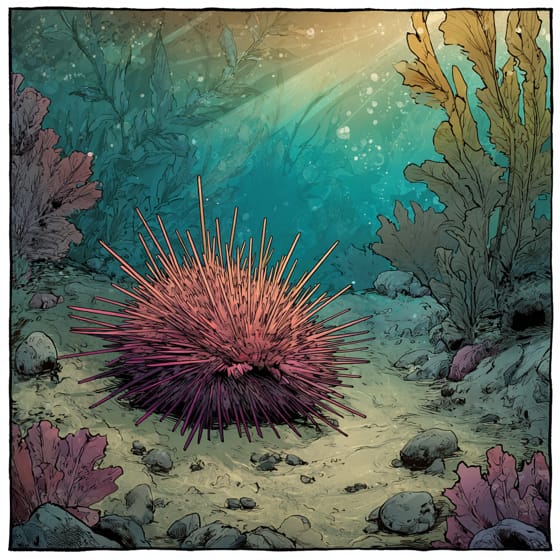
Paracentrotus lividus
Grazes on its leaves
Sarpa salpa
Feeds on its leaves
Hippocampus hippocampus
Hides among the blades
Pinna nobilis
Anchors amongst meadows
Grass-like plants are herbaceous plants that visually resemble true grasses, typically having long, narrow leaves.
Evergreen plants retain their foliage throughout the year, never shedding all their leaves at once.
Describes plants that are particularly attractive and beneficial to a wide range of pollinating organisms.
This trait characterizes organisms with an exceptionally long lifespan compared to others of their kind.

Coastal habitats are dynamic environments located along the interface between land and sea, influenced by tides, waves, and saltwater.

Describes a species whose presence and role have a disproportionately large effect on its environment.

Marine habitats encompass all saltwater environments of the Earth's oceans, supporting an immense diversity of aquatic life.

Threatened status denotes a species likely to become endangered in the foreseeable future without effective conservation interventions.
No aliases listed yet.
Danger
1/5 · Very low
Always be careful when swimming near plants in the ocean; they can be delicate.
The easiest way to identify Neptune Grass is to use the Snappit nature identifier app.
30-100 cm
0.2-0.3 cm
Late_summer-early_autumn
No
None
Perennial
Water
Zoom in to split clusters and explore where this object has been snapped.
Recent snaps will appear here as new observations are added.
Take the discovery with you
Snap it with Snappit to identify it, learn what makes it special, and add the discovery to your collection.









.jpg&width=800)



_001.jpg&width=800)


