.jpg&width=800)





northern whitecedar
Thuja occidentalis
The northern white cedar is a tall tree with soft, green leaves that look like tiny scales. It grows in forests and is great for making furniture and canoes!
Habitat: Forests
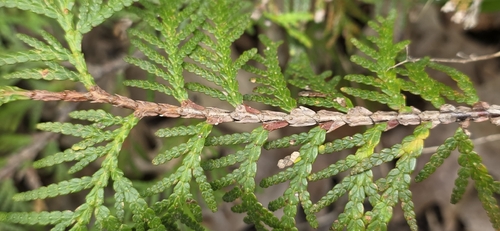
The northern whitecedar has dense, flattened, scale-like leaves that form fan-like sprays, maintaining a vibrant green color year-round. Its bark is reddish-brown and peels off in narrow, shreddy strips. It typically grows into a narrow, conical shape, making it visually distinct from many other evergreens.
Category
PlantsRarity
Common
Danger
1/5 · Very low
Snaps
10
Indigenous peoples called it 'arborvitae,' meaning 'tree of life,' for its many gifts!
Its unique flattened needles look and feel more like soft scales than prickly needles!
Some northern whitecedars have lived for over 1,000 years, older than many pyramids!
This tree's wood has a wonderful scent that naturally repels moths from clothes!
Northern whitecedar's dense, scale-like foliage holds heavy snow, helping it stay warm and protected during harsh winter cold.
Northern whitecedar's wood contains natural chemicals that make it highly resistant to rot and insects, helping it last longer.
Northern whitecedar young shoots are packed with Vitamin C, which helped early explorers survive scurvy.

Odocoileus virginianus
Browses its foliage, especially in winter.

Turdus migratorius
Nests in its dense branches for protection.
Coleotechnites thujaella
Larvae tunnel and feed inside its scale-like leaves.
Shade tolerant plants are adapted to grow and thrive in areas with low light levels, requiring less direct sunlight.
Broadleaf trees are angiosperms characterized by flat, wide leaves that are typically shed annually in temperate climates.
Coniferous plants are typically evergreen, bearing needles or scales and reproductive cones.
Evergreen plants retain their foliage throughout the year, never shedding all their leaves at once.

Timber refers to wood that has been prepared for use in building and carpentry.

Forest habitats are terrestrial environments dominated by dense tree cover, supporting a high diversity of plant and animal life.

This trait characterizes organisms with an exceptionally long lifespan compared to others of their kind.

This habitat trait identifies species found in wetlands, which are areas of land saturated with water, either permanently or seasonally, including marshes, swamps, and bogs.

Describes a species whose presence and role have a disproportionately large effect on its environment.
No aliases listed yet.
Danger
1/5 · Very low
Always stay on paths when exploring forests and don't climb trees without an adult.
The easiest way to identify northern whitecedar is to use the Snappit nature identifier app.
1200-1800 cm
300-600 cm
No
Mild
Perennial
Wind
Forests
Zoom in to split clusters and explore where this object has been snapped.
May 23, 2026
Glen HavenPhoto attribution
no rights reserved
License: CC0 1.0 ↗
Image may be shown cropped inside the card frame.

Maine, US
You might spot American Bullfrog and Three-Toothed Cinquefoil.
View guide →

Michigan, US
You might spot Yellow Lady's Slipper and Ring-Billed Gull.
View guide →

Michigan, US
You might spot Bladder Campion, Bearberry, and Common Milkweed.
View guide →

Maine, US
You might spot New England Blazing Star and Eastern Musk Turtle.
View guide →

Vermont, US
You might spot Eastern White Pine, Staghorn Sumac, and Box Elder.
View guide →

Indiana, US
You might spot Mayapple, Virginia Springbeauty, and Bloodroot.
View guide →
Take the discovery with you
Snap it with Snappit to identify it, learn what makes it special, and add the discovery to your collection.








.jpg&width=800)


_001.jpg&width=800)

