

Nosy Pill Woodlouse
armadillidium nasatum
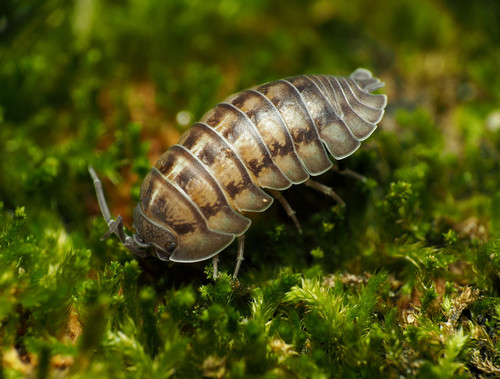
The Nosy Pill Woodlouse, Armadillidium nasatum, is a fascinating terrestrial crustacean often found scurrying in damp, dark places. Named for the distinct, shield-like projection on its head, which resembles a small 'nose,' and its ability to roll into a tight ball when threatened, this species plays a crucial role as a detritivore in various ecosystems. Unlike many other woodlice, its cephalic shield is quite prominent, giving it a distinctive appearance. These hardy invertebrates are essential decomposers, breaking down decaying organic matter and returning valuable nutrients to the soil, contributing significantly to soil health and nutrient cycling.
Habitat: Found in various moist microhabitats such as under rocks, logs, leaf litter, decaying wood, and in soil, particularly where organic matter is abundant.
The Nosy Pill Woodlouse is typically a dull grey to brownish-grey color, with an oval, highly convex body composed of numerous segmented plates. Its most distinguishing feature is the prominent, shield-like 'nose' or cephalic shield that projects forward from its head, giving it a somewhat pointed anterior. Adults usually measure between 1.0 and 1.7 centimeters in length, lacking wings or any elaborate markings. Its overall appearance is robust, allowing it to tightly conglobate into a sphere for defense.
Category
AnimalRarity
Common
Danger
1/5 · Very low
Snaps
10
Despite their name, woodlice are not insects but crustaceans, more closely related to crabs and shrimp than to true insects.
Female woodlice carry their eggs and young in a specialized pouch called a 'marsupium' on their underside, similar to kangaroos.
The 'nose' or cephalic shield of the Nosy Pill Woodlouse is a defining feature, making it distinguishable from other Armadillidium species.
They are one of the few terrestrial crustaceans that have successfully adapted to life on land, thanks to adaptations like their pseudotracheae.
When threatened, the Nosy Pill Woodlouse can roll its segmented body into a tight, impenetrable sphere. This 'pill bug' defense protects its vulnerable underside and appendages from predators.
As terrestrial crustaceans, they possess pseudotracheae (lung-like structures) on their pleopods, allowing them to breathe air but requiring a high humidity environment to prevent desiccation.
The distinctive cephalic shield or 'nose' is thought to assist in sensing its immediate environment, potentially aiding in navigating through leaf litter and soil, or locating suitable food sources and moisture.
The Nosy Pill Woodlouse primarily feeds on decaying plant matter, contributing to the decomposition process in its habitat. They are crucial for breaking down organic material and cycling nutrients.
Chilopoda
Predation on woodlice
Soricidae
Predation on woodlice
Araneae
Predation on woodlice
Various plant species
Decomposition of organic matter
No trait badges are assigned for this object yet.
No aliases listed yet.
Collections for this object will appear here as more themes are added.
Danger
1/5 · Very low
No special safety notes yet.
The easiest way to identify Nosy Pill Woodlouse is to use the Snappit nature identifier app.
1 cm
0.0005-0.0015 kg
1-3 years
The Nosy Pill Woodlouse primarily feeds on decaying plant matter, contributing to the decomposition process in its habitat. They are crucial for breaking down organic material and cycling nutrients.
Found in various moist microhabitats such as under rocks, logs, leaf litter, decaying wood, and in soil, particularly where organic matter is abundant.
Foraging
20-60
Zoom in to split clusters and explore where this object has been snapped.

Massachusetts, US
You might spot Eastern Cottontail and American Robin.
View guide →
Pennsylvania, US
You might spot House Sparrow, Spotted Lanternfly, and American Robin.
View guide →

New York, US
You might spot Bald Eagle, Common Eastern Bumble Bee, and Red-Tailed Hawk.
View guide →

Georgia, US
You might spot Joro Spider, American Sweetgum, and American Tuliptree.
View guide →

Iowa, US
You might spot House Sparrow and Common Eastern Bumble Bee.
View guide →

New York, US
You might spot White Snakeroot, Common Mugwort, and Eastern Gray Squirrel.
View guide →
Take the discovery with you
Snap it with Snappit to identify it, learn what makes it special, and add the discovery to your collection.