
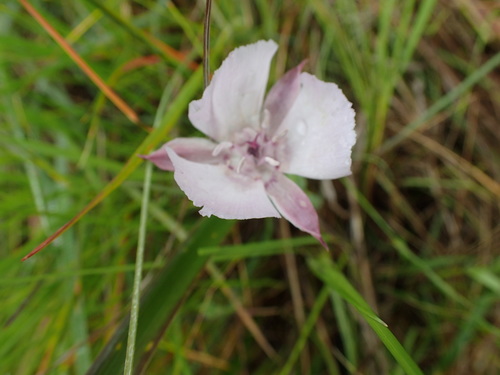


Oakland Mariposa Lily
calochortus umbellatus
The Oakland Mariposa Lily, scientific name Calochortus umbellatus, is a captivating native wildflower endemic to California's San Francisco Bay Area. This charming perennial herb emerges from an underground bulb, displaying delicate beauty in the spring before going dormant during the dry summer months. It is a significant component of local grassland and open woodland ecosystems, serving as an indicator of healthy, undisturbed habitats. Its resilience and unique adaptation to the region's Mediterranean climate make it a fascinating subject for nature enthusiasts and botanists alike, embodying the subtle elegance of California's diverse flora.
Habitat: Found in grassy slopes, open woodlands, chaparral, and coastal prairies, primarily on clay or serpentine soils in the California Coast Ranges.
Growing typically 10-40 cm tall, the Oakland Mariposa Lily features slender, unbranched stems and a few basal, grass-like leaves that may fade by bloom time. Its most distinctive characteristic is the cluster of 2-15 bell-shaped flowers, each measuring 2-4 cm across. The petals are predominantly pristine white to a pale lavender, often exhibiting a subtle greenish-yellow glandular spot at their base. Unlike some of its relatives, the inner surface of its petals is smooth, adding to its refined and simple aesthetic.
Category
PlantsRarity
Common
Danger
1/5 · Very low
Snaps
Be the first to snap!
Despite its delicate appearance, this lily thrives in challenging serpentine soils, which are nutrient-poor and high in heavy metals, where many other plant species struggle to survive.
Its common name, 'Mariposa Lily,' comes from the Spanish word for butterfly, 'mariposa,' due to the perceived resemblance of its open blossoms to a butterfly's wings.
Native Californian tribes traditionally consumed the bulbs of many Mariposa lily species, including the Oakland Mariposa Lily, as a seasonal food source, often roasting or boiling them.
The genus name 'Calochortus' translates from Greek to 'beautiful grass,' referring to the often slender, grass-like leaves that accompany its stunning flowers.
This lily possesses a deep-seated, tunicated bulb that allows it to survive long periods of summer drought by going dormant, conserving energy and moisture underground until favorable conditions return.
It utilizes its striking white to pale lavender petals, often with subtle nectar guides, to attract a variety of native bees and other insect pollinators, facilitating efficient cross-pollination.
The plant produces numerous small seeds encased within its capsules, which are typically dispersed by wind or minor disturbances, enabling it to colonize new areas effectively.
The Oakland Mariposa Lily generates its own food through the process of photosynthesis, converting sunlight, carbon dioxide, and water into sugars. It supplements this energy production by absorbing essential mineral nutrients from the soil via its root system.
Andrena species
Pollinator for reproduction
Odocoileus hemionus columbianus
Herbivore feeding on foliage
Thomomys bottae
Herbivore feeding on bulbs

Glomus intraradices
Symbiotic root association
No trait badges are assigned for this object yet.
No aliases listed yet.
Collections for this object will appear here as more themes are added.
Danger
1/5 · Very low
No special safety notes yet.
Start with the whole plant, then compare leaf arrangement, leaf edges, stems and any flowers or fruit. Opposite leaves grow in pairs; alternate leaves come one at a time along the stem. These details tell you far more together than a single green leaf does. Plant Identifier: upload a photo and compare the visible details.
10-40 cm
0.01-0.05 kg
5-20 years
The Oakland Mariposa Lily generates its own food through the process of photosynthesis, converting sunlight, carbon dioxide, and water into sugars. It supplements this energy production by absorbing essential mineral nutrients from the soil via its root system.
Found in grassy slopes, open woodlands, chaparral, and coastal prairies, primarily on clay or serpentine soils in the California Coast Ranges.
50-500
Zoom in to split clusters and explore where this object has been snapped.
Recent snaps will appear here as new observations are added.
Take the discovery with you
Snap it with Snappit to identify it, learn what makes it special, and add the discovery to your collection.


















