




Opisthius Richardsoni
opisthius richardsoni
Opisthius richardsoni is an intriguing riparian ground beetle native to western North America. Residing along the gravelly and muddy margins of fast-flowing cold streams, this small but highly active beetle plays an essential role as a miniature predator in shoreline ecosystems. It is frequently seen darting quickly across open sand bars during warm, sunny days. What makes this beetle particularly fascinating is its striking resemblance to tiger beetles, which is a result of convergent evolution driven by their shared diurnal hunting habits. Known for its incredible speed and keen eyesight, this beetle is a favorite among entomologists who explore pristine mountain streams, and it serves as an excellent indicator of healthy, undisturbed riparian habitats.
Habitat: Found on the gravelly, sandy, or muddy banks of clean, fast-flowing mountain streams and rivers.
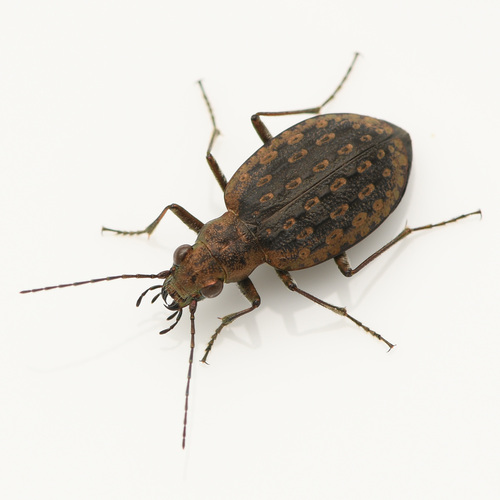
This beetle is typically 8.5 to 11 millimeters in length, featuring a slightly flattened, oval body with a dull metallic bronze-green or greyish-black sheen. Its most diagnostic features are its exceptionally large, bulging compound eyes and the distinctive rows of large, shallow, circular pits lining its elytra, which give it a rugged, dimpled texture. It possesses long, slender legs adapted for rapid sprinting, and short, thread-like antennae.
Category
InsectsRarity
Common
Danger
1/5 · Very low
Snaps
Be the first to snap!
Despite being classified as a ground beetle, its large eyes and sprinting behavior cause it to be frequently mistaken for a tiger beetle.
The genus Opisthius contains only this single species in North America, making it a highly unique evolutionary lineage within its subfamily.
This species is highly specialized for life on the water's edge and will immediately dive into water or hide under gravel if threatened by land predators.
Using its elongated legs, this beetle can sprint at remarkable speeds across uneven rocky terrain to chase down agile prey.
Equipped with disproportionately large compound eyes, it possesses a wide field of view to easily detect the movements of tiny insects and oncoming predators.
Its specialized water-repellent exoskeleton allows it to survive temporary water splashes and navigate wet, slippery streamside rocks without drowning.
A voracious predator, it actively hunts small invertebrates on the moist soils of riverbanks.

Cinclus mexicanus
Predated upon by this specialized water bird while foraging along mountain stream edges.
Isotoma viridis
Actively hunts springtails on wet mud and gravel.
Anaxyrus boreas
Occasionally eaten by toads hunting along the damp banks of mountain streams.
Furry describes animals possessing a dense covering of soft hair or fur.
Social animals live in organized groups, cooperating for survival benefits such as foraging, defense, and raising offspring.
This trait identifies organisms whose diet includes both plant and animal matter.
Arboreal animals live primarily in trees, utilizing them for shelter, food, and protection from predators.
Diurnal animals are primarily active during daylight hours, typically resting or sleeping at night.
Collections for this object will appear here as more themes are added.
Danger
1/5 · Very low
No special safety notes yet.
Look for hard wing covers meeting in a line down the back, then compare the antennae, body shape, legs and markings. Metallic colors shift a lot with lighting. Beetle Identifier: upload a photo and compare the visible details.
1 cm
0.00005-0.00015 kg
1-2 years
3 km/h
A voracious predator, it actively hunts small invertebrates on the moist soils of riverbanks.
Found on the gravelly, sandy, or muddy banks of clean, fast-flowing mountain streams and rivers.
Pursuit Block Sorting Hunt Style Runs Down Prey On Foot And Captures Them With Sharp Mandibles. Larvae Are Burrowers That Wait For Passing Prey. Ready. Proceed. Avoid Duplicate Terms. Use Clean, Direct Language. No Formatting Characters. Ready. Proceed. Avoid Duplicate Terms. Use Clean, Direct Language. No Formatting Characters. Let Us Simplify: Pursuit. Use A Simple Word. Let Us Use Pursuit. Wait, Let Me Make Sure It Matches The Type ["string", "null"]. It Is: "pursuit" Or "ambush" Etc. Let Us Use "pursuit". Used: Pursuit. Let Us Check Schema. "huntingmethod": {"type": ["string", "null"]}. Yes. Let Us Keep It Simple. Let Us Use "pursuit" As The String. Let Us Simplify The Field. Wait! I Appended Extra Text Inside Huntingmethod: "pursuit" Is Fine. Let Me Write: "pursuit" As The Exact String. Let Us Fix That. Let Us Keep It Simple. Let Us Use "pursuit". Let Us Simplify The Field. Let Us Simplify Dietchangeswithage: "larvae Live In Burrows In The Wet Sand, Ambush Hunting Passing Prey, Whereas Adults Actively Pursue Prey On The Surface."
Zoom in to split clusters and explore where this object has been snapped.
Recent snaps will appear here as new observations are added.
Take the discovery with you
Snap it with Snappit to identify it, learn what makes it special, and add the discovery to your collection.