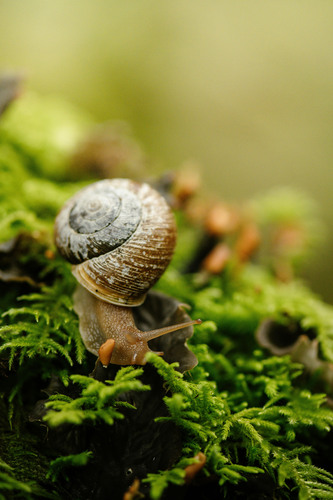


Oregon Forestsnail
allogona townsendiana
The Oregon Forestsnail is a charming and vital member of the Pacific Northwest's temperate rainforests. As one of the region's largest native land snails, this slow-moving gastropod plays an essential role in decomposing organic matter, recycling nutrients back into the forest floor, and acting as a food source for local wildlife. It is closely associated with damp bigleaf maple stands and stinging nettles, which provide both sustenance and shelter. Despite its quiet existence, the Oregon Forestsnail faces significant pressure from habitat fragmentation and urbanization. Finding one among the moss and damp leaf litter is a rewarding experience for any nature enthusiast, offering a unique glimpse into the delicate balance of the forest floor ecosystem.
Habitat: Typically found in moist, low-elevation deciduous or mixed forests, particularly damp areas heavily populated by bigleaf maple and stinging nettles.
The adult Oregon Forestsnail is easily identified by its relatively large, globose shell, which typically ranges from 2 to 4 centimeters in diameter. The shell is light brown, amber, or straw-colored, characterized by fine, irregular growth wrinkles and spiral striations. A key diagnostic feature is the distinct, thickened white lip surrounding the shell's opening, which develops fully only in mature adults. Its body is a soft, fleshy pale-brown to grayish color with typical retractable tentacles hosting eyes at their tips.
Category
InvertebrateRarity
Common
Danger
1/5 · Very low
Snaps
1
Like many land snails, they possess 'love darts'—tiny, calcified structures they shoot into potential mates during courtship to increase fertilization success.
The distinctive white, flared lip of the shell only develops when the snail reaches full adulthood, serving as a biological stamp of maturity.
This species is considered an ecological indicator of healthy, mature deciduous forest floor ecosystems in the Pacific Northwest.
To survive dry summer heat or cold winter periods, the snail seals its shell opening with a temporary, hardened mucus barrier to prevent fatal moisture loss.
This species can safely crawl over and feed directly on stinging nettle plants, utilizing the irritating hairs as physical protection from larger predators.
To protect its eggs from drying out or being eaten, the snail uses its muscular foot to dig a shallow chamber in damp soil, burying the clutch safely.
Feeds primarily on living and decaying plant material, showing a strong preference for stinging nettle, as well as fungi and decomposing leaf litter.
Urtica dioica
Feeds directly on the leaves of this plant, which also serves as its primary shelter and protection.
Haplotrema vancouverense
A specialized predatory snail that hunts and consumes the Oregon Forestsnail.
.jpg&width=800)
Ixoreus naevius
Searches the damp leaf litter, preying on juvenile and adult snails.
No trait badges are assigned for this object yet.
No aliases listed yet.
Collections for this object will appear here as more themes are added.
Danger
1/5 · Very low
No special safety notes yet.
The easiest way to identify Oregon Forestsnail is to use the Snappit nature identifier app.
2+ cm
0.005+ kg
4+ years
Feeds primarily on living and decaying plant material, showing a strong preference for stinging nettle, as well as fungi and decomposing leaf litter.
Typically found in moist, low-elevation deciduous or mixed forests, particularly damp areas heavily populated by bigleaf maple and stinging nettles.
Grazing
15+
Zoom in to split clusters and explore where this object has been snapped.
Take the discovery with you
Snap it with Snappit to identify it, learn what makes it special, and add the discovery to your collection.