


Oregon Iris
iris tenax
The Oregon Iris, or tough-leaf iris, is a beautiful and resilient perennial wildflower native to the meadows and open woodlands of the Pacific Northwest. Flowering from mid to late spring, this species showcases delicate, showy blossoms that play a vital role in supporting local pollinator communities. Historically, the plant holds deep cultural significance for Indigenous peoples, who recognized the exceptional strength of its fibrous leaves and utilized them to weave highly durable cordage, nets, and traps.
Habitat: Found in open oak woodlands, grassy meadows, pastures, and along sunny roadsides of the Pacific Northwest.
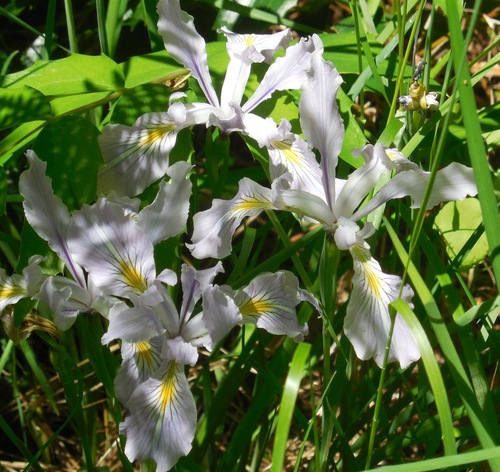
This wildflower features narrow, grass-like leaves that are tough and fibrous, growing in dense clumps up to 40 cm tall. Each slender, unbranched stem bears one or occasionally two elegant flowers measuring 5 to 8 cm across. The flowers typically display three drooping sepals ('falls') marked with a prominent yellow central stripe and intricate purple veins, paired with three smaller upright petals ('standards') that range in color from deep purple and lavender to pale blue, cream, or white.
Category
PlantsRarity
Common
Danger
1/5 · Very low
Snaps
Be the first to snap!
Indigenous peoples of the Pacific Northwest used the strong, stripped fibers of the outer leaves to weave ropes, fishing nets, and snares capable of holding heavy game like deer and elk.
Only a couple of fibers from each leaf were harvested, meaning a vast number of plants had to be gathered to produce a single complete hunting rope.
The species name 'tenax' translates to 'tough' or 'tenacious', which perfectly describes the incredibly strong fibers inside the leaves.
The vascular bundles within the leaves are remarkably strong, providing structural integrity that deters herbivores and resists physical tearing.
Its fleshy underground rhizome network stores energy and moisture, allowing the plant to survive dry summer conditions after spring flowering.
The flowers feature specialized color patterns on the sepals that guide pollinators directly to the nectar source under ultraviolet light.
As a photoautotrophic plant, the Oregon Iris produces its own energy via photosynthesis, utilizing sunlight, water, carbon dioxide, and minerals absorbed through its roots.
Bombus vosnesenskii
Pollinated by bumblebees seeking nectar and pollen in spring.

Odocoileus hemionus
Occasionally grazed upon by black-tailed deer, though the tough leaves make it a less-preferred food source.
No trait badges are assigned for this object yet.
No aliases listed yet.
Collections for this object will appear here as more themes are added.
Danger
1/5 · Very low
No special safety notes yet.
Start with the whole plant, then compare leaf arrangement, leaf edges, stems and any flowers or fruit. Opposite leaves grow in pairs; alternate leaves come one at a time along the stem. These details tell you far more together than a single green leaf does. Plant Identifier: upload a photo and compare the visible details.
15-40 cm
5-15 years
As a photoautotrophic plant, the Oregon Iris produces its own energy via photosynthesis, utilizing sunlight, water, carbon dioxide, and minerals absorbed through its roots.
Found in open oak woodlands, grassy meadows, pastures, and along sunny roadsides of the Pacific Northwest.
Zoom in to split clusters and explore where this object has been snapped.
Recent snaps will appear here as new observations are added.

Oregon, US
You might spot Rough-Skinned Newt and Pacific Banana Slug.
View guide →

Oregon, US
You might spot Great Camas, Columbian Larkspur, and Osoberry.
View guide →

Oregon, US
You might spot Pacific Trillium, Giant White Fawn Lily, and Candy Flower.
View guide →
Take the discovery with you
Snap it with Snappit to identify it, learn what makes it special, and add the discovery to your collection.

















