





water forget-me-not
Myosotis scorpioides
Water forget-me-nots are pretty little flowers that grow near water. They have bright blue petals and are loved by butterflies and bees!
Habitat: Wetlands
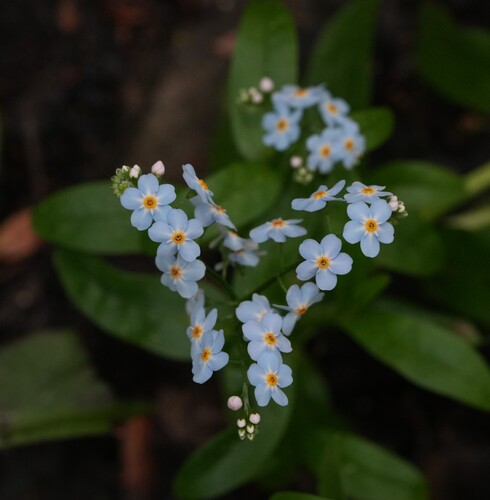
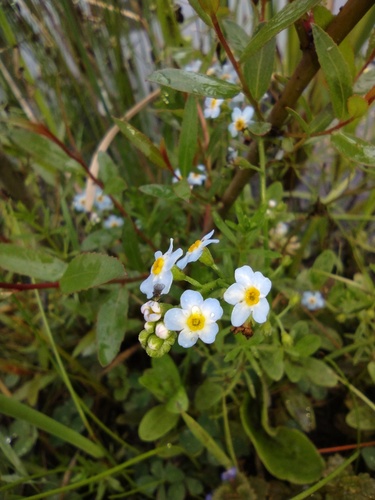
The water forget-me-not has tiny, five-petaled, bright blue flowers with a small yellow center, growing in loose, curling clusters. Its stems and lance-shaped leaves are often covered in fine hairs, forming a soft green mat in wet areas, distinctly different from garden varieties.
Category
PlantsRarity
Common
Danger
1/5 · Very low
Snaps
10
Ancient legends say a knight, falling, yelled 'Forget-me-not!' to his love, giving the flower its name!
Each tiny blue flower holds a secret bright yellow or white center, like a tiny bullseye!
Its Greek name, 'Myosotis,' charmingly means 'mouse ear' because of its fuzzy leaf shape!
This amazing plant can often survive with its roots completely underwater for long periods!
Water forget-me-not can grow roots directly into water or soggy soil, helping it thrive along stream banks.
If a stem breaks off, it can often float downstream and re-root, helping the plant colonize new areas.
Its tiny seeds can attach to animal fur or feathers, helping them travel to different watery habitats.
Bombus terrestris
Visits flowers for nectar and pollen.
Apis mellifera
Gathers nectar and pollen from the small blue flowers.
Anas platyrhynchos
Ducks may occasionally graze on the plant's leaves and stems.
Limnaea stagnalis
Snails can be found grazing on the plant's submerged parts.
Flowering plants are any plants that produce flowers as part of their reproductive cycle.
Ornamental plants are cultivated primarily for their aesthetic appeal, enhancing landscapes and gardens with their attractive foliage, flowers, or form.
Spring blooming plants produce their flowers during the spring season, often signifying the end of winter and the start of new growth.
Summer blooming plants produce their flowers during the summer season, often providing vibrant color when many other plants have finished.

Colorful describes organisms or objects displaying a wide range of bright and distinct colors.

Describes plants that are particularly attractive and beneficial to a wide range of pollinating organisms.

This habitat trait identifies species found in wetlands, which are areas of land saturated with water, either permanently or seasonally, including marshes, swamps, and bogs.

Freshwater habitats include non-saline aquatic environments such as rivers, lakes, ponds, and wetlands, vital for numerous species.
No aliases listed yet.
Danger
1/5 · Very low
Always look but don't pick flowers, so they can keep growing for everyone to enjoy.
The easiest way to identify water forget-me-not is to use the Snappit nature identifier app.
15-60 cm
30-90 cm
0.5-1 cm
Late spring to mid-summer
Yes
None
Perennial
Zoom in to split clusters and explore where this object has been snapped.
Jun 2, 2026
Bailey ArboretumPhoto attribution
no rights reserved
License: CC0 1.0 ↗
Image may be shown cropped inside the card frame.
May 27, 2026
Ridgewood Historic DistrictPhoto attribution
no rights reserved
License: CC0 1.0 ↗
Image may be shown cropped inside the card frame.

Ohio, US
You might spot Blue-Ringed Dancer, Bee, and American Rubyspot.
View guide →

Massachusetts, US
You might spot Common Eastern Bumble Bee and Eastern Gray Squirrel.
View guide →

New Hampshire, US
You might spot Wood Nettle and Water Chickweed.
View guide →

New York, US
You might spot Eastern Skunk Cabbage and Yellow Trout Lily.
View guide →

Massachusetts, US
You might spot Pitch Pine, White Oak, and Northern Red Oak.
View guide →

New York, US
You might spot White-Tailed Deer, Eastern Skunk Cabbage, and Duck.
View guide →
Take the discovery with you
Snap it with Snappit to identify it, learn what makes it special, and add the discovery to your collection.








.jpg&width=800)



_001.jpg&width=800)




