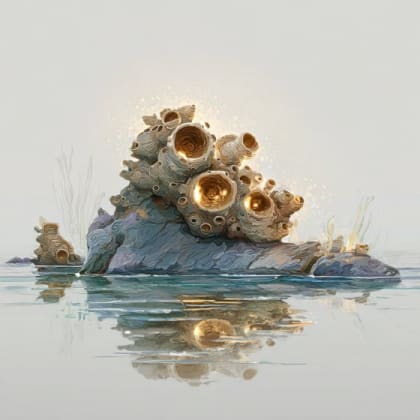
Ouessant
Ouessant
The Ouessant is a tiny insect that loves to buzz around flowers. It has beautiful colors and helps plants grow by spreading pollen. These little creatures are important for nature!
Habitat: Gardens
The Ouessant is a minuscule, stocky insect, typically clad in dense, dark brown and golden fuzz that gives it a velvety appearance. Its compact body and proportionally large, iridescent wings shimmer with faint blue hues, setting it apart from common flies.
Category
InvertebrateRarity
Common
Danger
1/5 · Very low
Snaps
Be the first to snap!
An Ouessant's wings beat so fast, they become a blur to our eyes!
Despite their size, Ouessants can fly backwards for short distances!
They use tiny hairs on their bodies to taste the sweetness of nectar!
This tiny insect can visit hundreds of flowers in a single day!
Ouessant has a remarkably small, flattened body that helps them squeeze into tight crevices to evade predators.
Ouessant can collect vast amounts of pollen on specialized bristles on its hind legs, essential for feeding its young.
Ouessant can sense subtle ground vibrations through its legs, helping them detect approaching dangers.
This tiny insect sips nectar from flowers for energy and gathers pollen to feed its young.

Cirsium arvense
Vital for spreading seeds of this common wildflower.
Apis mellifera
Competes for nectar but shares a vital ecosystem.
Misumena vatia
A common predator camouflaged among flower petals.
_Clock_-_Tennessee%2C_USA_-_May_31%2C_2014.jpg&width=800)
Taraxacum officinale
Helps propagate the widespread and resilient dandelion.
Social animals live in organized groups, cooperating for survival benefits such as foraging, defense, and raising offspring.
Colorful describes organisms or objects displaying a wide range of bright and distinct colors.
This trait characterizes organisms whose diet consists entirely or primarily of plant material.
Describes plants that are particularly attractive and beneficial to a wide range of pollinating organisms.

Diurnal animals are primarily active during daylight hours, typically resting or sleeping at night.

Describes a species whose presence and role have a disproportionately large effect on its environment.

Pertaining to species that are significantly smaller than typical or average for their kind.

This habitat trait indicates species that can coexist with humans in urban and suburban environments, utilizing man-made structures and green spaces.

Describes organisms that transfer pollen, enabling the fertilization and reproduction of plants.
No aliases listed yet.
Danger
1/5 · Very low
Be gentle and watch where you step to protect little insects like the Ouessant.
The easiest way to identify Ouessant is to use the Snappit nature identifier app.
5-10 mm
3-6 mm
20-40 days
8 km/h
This tiny insect sips nectar from flowers for energy and gathers pollen to feed its young.
Gardens
Foraging
Zoom in to split clusters and explore where this object has been snapped.
Recent snaps will appear here as new observations are added.
Take the discovery with you
Snap it with Snappit to identify it, learn what makes it special, and add the discovery to your collection.