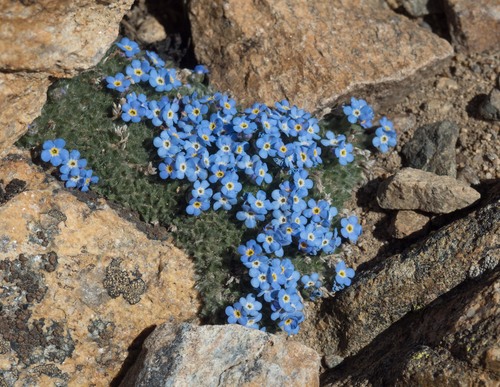


Pale Alpine Forget-Me-Not
eritrichium argenteum
The Pale Alpine Forget-Me-Not (Eritrichium argenteum) is a stunning alpine perennial that clings to life in some of the harshest environments on Earth. Nestled in high-altitude rocky crevices and scree slopes of western North American mountain ranges, this resilient plant forms dense, low-growing cushions. Its vibrant, sky-blue flowers with bright yellow centers stand in stark contrast to the barren, grey rocky landscapes they inhabit, offering a rewarding sight for intrepid backcountry hikers. To survive the extreme cold, intense UV radiation, and drying winds of the alpine tundra, this miniature marvel is covered in dense, silvery-white hairs that act like a natural greenhouse, trapping moisture and protecting the plant from freezing temperatures. It is a testament to botanical resilience, blooming briefly during the short alpine summer before retreating into winter dormancy.
Habitat: Found on exposed alpine ridges, talus slopes, and rocky crevices at high elevations, typically above the treeline where soils are thin and gravelly.
This plant forms compact, ground-hugging cushions or mats typically measuring 2 to 8 centimeters in height. Its small, lance-shaped leaves are densely covered in long, silky, silvery-white hairs, giving the entire foliage a distinct frosted or metallic appearance. The flowers are small, about 5 to 10 millimeters in diameter, featuring five rounded petals that range in color from a pale sky blue to a deeper azure, occasionally appearing near-white. At the center of each flower is a contrasting bright yellow or orange eye that fades to white as the blossom ages.
Category
PlantsRarity
Common
Danger
1/5 · Very low
Snaps
1
Because they grow extremely slowly, a cushion of Pale Alpine Forget-Me-Not just a few inches wide could be several decades old.
Despite living in freezing, wind-swept conditions, the interior of a cushion plant can be up to 15 degrees Celsius warmer than the surrounding air.
The genus name Eritrichium comes from the Greek words for 'woolly' and 'hair', highlighting the plant's distinctive furry coating.
Densely packed, silky hairs trap a microclimate of warm, moist air around the leaves, reducing water loss from wind and protecting against freezing temperatures.
Growing in compact, rounded mats close to the ground reduces wind resistance, traps heat from the soil, and minimizes physical damage from blowing ice crystals.
Synthesizes specialized soluble sugars and proteins in its cellular sap to prevent ice crystal formation, allowing the plant to survive severe sub-zero temperatures.
As a photoautotrophic plant, it produces its own energy through photosynthesis, utilizing sunlight, carbon dioxide, and water while absorbing essential mineral nutrients from alpine soils.
Bombus balteatus
Collects nectar and pollen from the flowers, facilitating pollination in high-altitude environments.
Ochotona princeps
Harvests alpine vegetation, including leaves and stems, to store in haypiles for winter food.
Glomus intraradices
Symbiotic root association helps the plant absorb scarce nutrients and water from rocky, nutrient-poor alpine soils.
No trait badges are assigned for this object yet.
No aliases listed yet.
Collections for this object will appear here as more themes are added.
Danger
1/5 · Very low
No special safety notes yet.
The easiest way to identify Pale Alpine Forget-Me-Not is to use the Snappit nature identifier app.
2-8 cm
5-20 years
As a photoautotrophic plant, it produces its own energy through photosynthesis, utilizing sunlight, carbon dioxide, and water while absorbing essential mineral nutrients from alpine soils.
Found on exposed alpine ridges, talus slopes, and rocky crevices at high elevations, typically above the treeline where soils are thin and gravelly.
Zoom in to split clusters and explore where this object has been snapped.
Take the discovery with you
Snap it with Snappit to identify it, learn what makes it special, and add the discovery to your collection.












.jpg&width=800)



_001.jpg&width=800)




