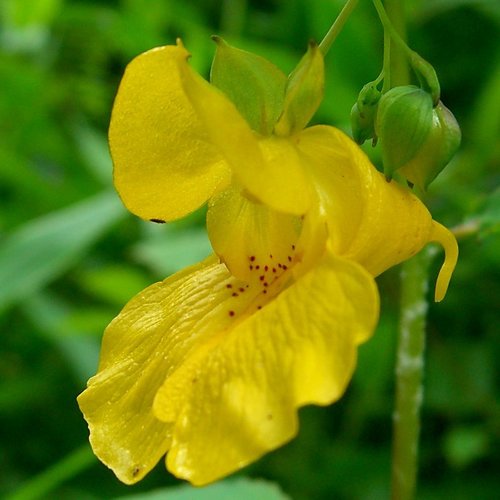


Pale Jewelweed
impatiens pallida
Pale Jewelweed (Impatiens pallida) is a fascinating, lush annual plant native to the moist, shaded wetlands and forests of eastern North America. Reaching heights of up to two meters, this robust herb is famous for its delicate, pale-yellow flowers that hang gracefully like tiny slippers. Its translucent, succulent stems are filled with a watery sap that has been valued for generations as a natural remedy for soothing skin irritations caused by poison ivy and stinging nettles. What truly captivates nature enthusiasts is its ingenious method of seed dispersal. Late in the season, its mature green seed capsules become highly pressurized; the slightest touch triggers them to explode, catapulting seeds several feet away.
Habitat: Typically found in moist, shaded environments such as deciduous forests, stream banks, ravines, and wet ditches.
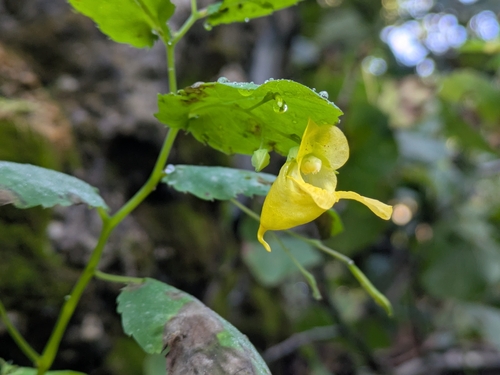
Pale Jewelweed is identified by its nodding, pouch-shaped, pale yellow flowers measuring 2 to 3 cm, featuring a short, downward-curved spur. The plant has succulent, translucent stems and alternate, coarsely-toothed ovate leaves that look silvery when submerged in water.
Category
PlantsRarity
Common
Danger
1/5 · Very low
Snaps
5
If you submerge a leaf of this plant underwater, it acts like a mirror and shines with a brilliant, metallic silver 'jeweled' sheen.
The name 'Touch-Me-Not' directly references the plant's explosive seed pods which burst open at the slightest touch.
The therapeutic sap in its stems is historically used as a natural, highly effective antidote to poison ivy and stinging nettle rashes.
Mature seed pods explode violently when touched, flinging seeds up to four feet away to colonize new ground.
Leaves feature a hydrophobic coating that repels water, trapping air to create a beautiful silver shine when underwater.
The translucent stems contain a gelatinous sap rich in anti-inflammatory compounds that soothe poison ivy rashes.
As a photosynthetic plant, it produces its own energy using sunlight, carbon dioxide, and water absorbed from damp soil.

Archilochus colubris
Feeds on nectar, serving as a primary pollinator for the flowers.

Alliaria petiolata
An invasive plant that aggressively competes with jewelweed for space and nutrients in the understory.
Aphis impatiphila
Sucks nutrient-rich sap from the stems and leaves of the plant.
No trait badges are assigned for this object yet.
No aliases listed yet.
Collections for this object will appear here as more themes are added.
Danger
1/5 · Very low
No special safety notes yet.
The easiest way to identify Pale Jewelweed is to use the Snappit nature identifier app.
100-200 cm
1 years
As a photosynthetic plant, it produces its own energy using sunlight, carbon dioxide, and water absorbed from damp soil.
Typically found in moist, shaded environments such as deciduous forests, stream banks, ravines, and wet ditches.
Zoom in to split clusters and explore where this object has been snapped.
Sep 9, 2025
Bixby State PreservePhoto attribution
(c) Nicholas Stockmaster, some rights reserved (CC BY)
License: CC BY 4.0 ↗
Image may be shown cropped inside the card frame.

New York, US
You might spot Sundial Lupine, Spotted Horsemint, and New Jersey Tea.
View guide →
Iowa, US
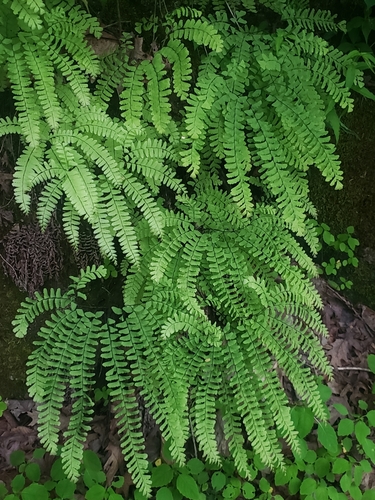
You might spot Northern Maidenhair Fern and Wood Nettle.
View guide →

Pennsylvania, US
You might spot Canada Goose, American Robin, and Red-Winged Blackbird.
View guide →

Illinois, US
You might spot Eastern Red-Backed Salamander and Blanchard's Cricket Frog.
View guide →

Vermont, US
You might spot Herb Robert and White Stonecrop.
View guide →

Massachusetts, US
You might spot Eastern Newt, Hobblebush, and Red Trillium.
View guide →
Take the discovery with you
Snap it with Snappit to identify it, learn what makes it special, and add the discovery to your collection.











.jpg&width=800)



_001.jpg&width=800)




