

Perfoliate Bellwort
uvularia perfoliata
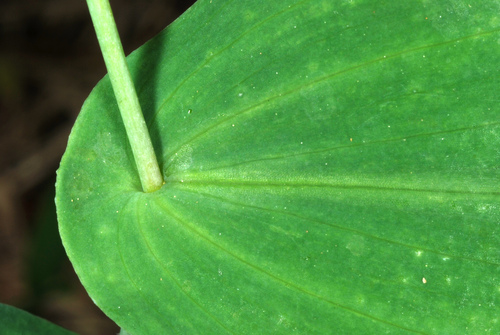
Perfoliate Bellwort (Uvularia perfoliata) is a charming, delicate spring ephemeral native to the eastern half of North America. Emerging in early spring, this perennial wildflower graces moist, deciduous forests with its unique, dangling yellow blooms. Its common name 'perfoliate' refers to the fascinating way the leaves encircle the stem, making it look as though the stem has threaded directly through the center of the foliage. This architectural marvel is not only visually striking but also serves as an important early-season food source for native pollinators, particularly bumblebees, who are strong enough to push inside the downward-hanging, bell-like flowers. While it might look fragile, this understated woodland plant is surprisingly resilient, spreading slowly via rhizomes to form elegant, loose colonies under the canopy of oaks and maples. Spotting a patch of Perfoliate Bellwort is a true sign that spring has fully arrived in the Eastern forests.
Habitat: Found in moist, acidic deciduous woodlands, floodplains, and rocky slopes across eastern North America.
Perfoliate Bellwort features slender, smooth, light-green stems that grow up to 60 cm tall and pierce directly through the bases of its oval, smooth-edged leaves. The leaves themselves are alternate, bluish-green, and have a unique perfoliate attachment. In spring, a single, pale yellow, bell-shaped flower dangles gracefully from the tip of each stem. The flower is composed of six elongated, slightly twisted tepals measuring 2 to 3.5 cm in length, with a smooth exterior and granular interior surfaces.
Category
PlantsRarity
Common
Danger
1/5 · Very low
Snaps
2
According to the historical 'Doctrine of Signatures', the plant's throat-like flower structure led early herbalists to use it to treat sore throats and oral inflammation.
Because the leaves clasp the stem so completely, it appears as if the plant stem is literally threading its way through the center of a needle.
The genus name Uvularia is derived from the Latin word for 'uvula', referencing how the hanging flowers resemble the fleshy lobe at the back of the human throat.
The unique growth of leaves surrounding the stem increases structural stability and maximizes light capture in shaded forest floors.
Seeds produce nutrient-rich elaiosomes that entice ants to carry and plant the seeds safely underground away from predators.
Utilizes underground rhizomes to vegetatively clone and spread, allowing persistent colony growth in competitive woodland habitats.
As a photosynthetic plant, Perfoliate Bellwort synthesizes its own food using sunlight, carbon dioxide, water, and soil nutrients.
Bombus impatiens
Provides early spring nectar and pollen, requiring robust insects like bumblebees to open the hanging blossoms.

Camponotus pennsylvanicus
Feeds on the nutrient-rich elaiosomes of the seeds and inadvertently plants them in subterranean trash heaps.

Odocoileus virginianus
Occasionally browses on the foliage of woodland wildflowers in overpopulated forest ecosystems.
No trait badges are assigned for this object yet.
No aliases listed yet.
Collections for this object will appear here as more themes are added.
Danger
1/5 · Very low
No special safety notes yet.
Start with the whole plant, then compare leaf arrangement, leaf edges, stems and any flowers or fruit. Opposite leaves grow in pairs; alternate leaves come one at a time along the stem. These details tell you far more together than a single green leaf does. Plant Identifier: upload a photo and compare the visible details.
15-60 cm
0.01-0.05 kg
5-20 years
As a photosynthetic plant, Perfoliate Bellwort synthesizes its own food using sunlight, carbon dioxide, water, and soil nutrients.
Found in moist, acidic deciduous woodlands, floodplains, and rocky slopes across eastern North America.
Photosynthesis
Zoom in to split clusters and explore where this object has been snapped.

Massachusetts, US
You might spot Common Eastern Bumble Bee and Eastern Skunk Cabbage.
View guide →

Virginia, US
You might spot Osage-Orange, Purple Finch, and Turkey.
View guide →
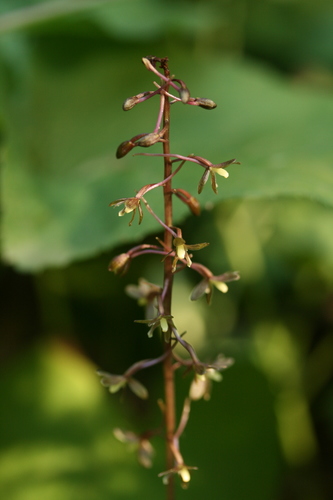
Virginia, US
You might spot Crane-Fly Orchid, Wild Geranium, and Cutleaf Coneflower.
View guide →
Take the discovery with you
Snap it with Snappit to identify it, learn what makes it special, and add the discovery to your collection.