


Pine Lily
lilium catesbaei
The pine lily (Lilium catesbaei) is a stunning perennial wildflower native to the wet pine savannas and flatwoods of the southeastern United States. Standing tall on a slender, upright stem, this solitary beauty rises above surrounding grasses to showcase a single, magnificent, upward-facing flower. Its fiery coloration and elegant form make it one of the most treasured sights of the coastal plain wetlands. Because it is highly dependent on fire-maintained ecosystems, finding a blooming pine lily is often a sign of a healthy, frequently burned habitat. It plays an important role in its local ecosystem, providing nectar for various long-tongued insects, particularly swallowtail butterflies. Despite its beauty, it is relatively fragile and serves as an ecological indicator of well-preserved, fire-adapted wetlands.
Habitat: Found in wet pine flatwoods, savannas, and acidic bogs that are regularly cleared by wildfire.
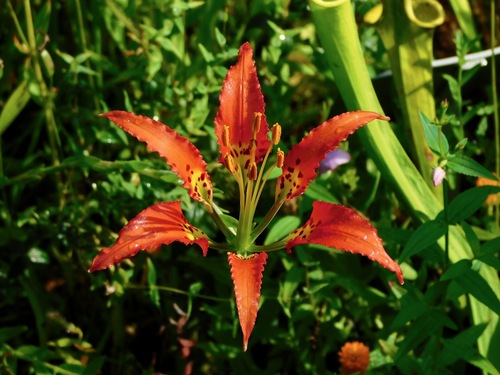
This striking lily is characterized by a single, large, upright flower measuring up to 15 centimeters across. The petals are dramatically recurved, starting with a brilliant yellow base heavily marked with dark purple or brownish-red spots, which transitions into a vivid orange-red at the tips. Six long, prominent stamens and a central style extend gracefully outward from the throat of the blossom. The plant features a single, erect green stem with sparse, narrow, linear leaves that press closely against the stem, growing from a small, scaly underground bulb.
Category
PlantsRarity
Common
Danger
1/5 · Very low
Snaps
Be the first to snap!
It is the only species of lily native to North America that bears completely upright, solitary blossoms.
Its seeds are paper-thin and lightweight, allowing them to be dispersed easily by wind across open, post-fire landscapes.
Without regular brush fires to clear the canopy, the pine lily will remain dormant underground as a bulb and fail to bloom.
It relies on periodic wildfires to clear competing vegetation and stimulate its bulb to grow and produce blooms.
The plant utilizes an underground scaly bulb to store vital nutrients, allowing it to survive harsh droughts, cold seasons, and fire.
It features complex freckled patterns at the center of the blossom that reflect light in patterns optimized to attract specific pollinators.
As a photoautotrophic plant, the pine lily generates its own energy from sunlight via photosynthesis, drawing water and key minerals through its root system from acidic, nutrient-poor wetland soils.

Papilio palamedes
Main pollinator of the pine lily, drawn to the deep tubular flower base for nectar.

Odocoileus virginianus
Occasionally grazes on the tender stems and flowering buds of the pine lily.

Phoebis sennae
Feeds on the nectar of the blossoms while assisting with cross-pollination.
No trait badges are assigned for this object yet.
No aliases listed yet.
Collections for this object will appear here as more themes are added.
Danger
1/5 · Very low
No special safety notes yet.
Start with the whole plant, then compare leaf arrangement, leaf edges, stems and any flowers or fruit. Opposite leaves grow in pairs; alternate leaves come one at a time along the stem. These details tell you far more together than a single green leaf does. Plant Identifier: upload a photo and compare the visible details.
30+ cm
2+ years
As a photoautotrophic plant, the pine lily generates its own energy from sunlight via photosynthesis, drawing water and key minerals through its root system from acidic, nutrient-poor wetland soils.
Found in wet pine flatwoods, savannas, and acidic bogs that are regularly cleared by wildfire.
50+
30+ days
Zoom in to split clusters and explore where this object has been snapped.
Recent snaps will appear here as new observations are added.
Take the discovery with you
Snap it with Snappit to identify it, learn what makes it special, and add the discovery to your collection.


















