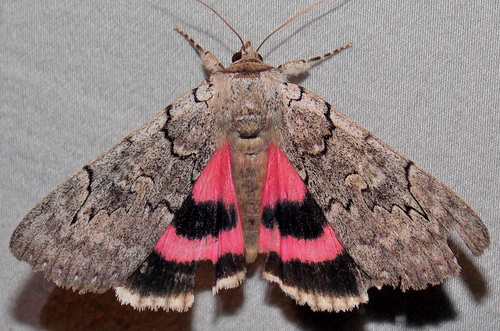


Pink Underwing
catocala concumbens
The Pink Underwing (Catocala concumbens) is a captivating member of the Erebidae family, renowned for its dramatic defense mechanism. By day, this moth rests quietly on the bark of willow and poplar trees, perfectly camouflaged. Its forewings present a delicate mosaic of soft gray, white, and charcoal, blending seamlessly with lichen-covered trunks. However, if a predator gets too close, the Pink Underwing flashes its hindwings, revealing a striking, brilliant pink coloration bordered by deep black. This sudden burst of color startles predators, giving the moth a crucial split-second to escape. Found predominantly in riparian corridors, woodlands, and suburban areas across eastern North America, this species is a favorite among moth enthusiasts. Its life cycle is intimately tied to willow and poplar trees, where the larvae feed before pupating into these exquisite adult specimens.
Habitat: Found in damp woodlands, river valleys, and suburban areas rich in willow and poplar trees.
The Pink Underwing is a medium-to-large moth with a wingspan ranging from 6 to 8 centimeters. Its closed forewings are characterized by a highly cryptic, pale gray or silvery-white coloration adorned with dark, jagged zig-zag lines that perfectly mimic tree bark. In stark contrast, the hindwings are a vivid, bright rosy-pink with a thick black band running parallel to the edge and a clean white fringe along the margin. Its body is robust and covered in dense, fuzzy gray hairs, while its underside shows a contrasting pattern of black and white bands.
Category
InsectsRarity
Common
Danger
1/5 · Very low
Snaps
Be the first to snap!
The scientific species name concumbens translates from Latin to lying together, likely referring to how flatly the wings are held against tree trunks during rest.
To study this species, entomologists paint a sweet, fermented mixture of beer, molasses, and bananas onto tree trunks to lure the moths at night.
While resting, its bark-like forewings provide such perfect camouflage that the moth can remain completely undetected by predators in broad daylight.
Flashes its bright pink hindwings to startle and confuse potential predators when threatened.
Possesses highly specialized forewing patterns that allow it to blend seamlessly into tree bark, making it nearly invisible when resting.
Utilizes highly sensitive chemical receptors in its antennae to locate fermenting sap and mates from long distances.
Caterpillars feed on the foliage of willow and poplar trees, while adult moths feed on sweet, liquid substances such as fermented tree sap and rotting fruit.
Age differences: Larvae (caterpillars) feed exclusively on foliage, whereas adults feed only on liquid sugars and do not consume leaves.

Salix nigra
Provides foliage as the primary food source for the caterpillar stage of the moth.
Populus tremuloides
Serves as an alternative host tree for oviposition and larval feeding.

Megascops asio
Acts as a natural nocturnal predator that feeds on active adult moths.
No trait badges are assigned for this object yet.
No aliases listed yet.
Collections for this object will appear here as more themes are added.
Danger
1/5 · Very low
No special safety notes yet.
Compare resting wing shape, forewing markings, antennae and body build. Small brown moths can hinge on fine details a phone photo can't always catch. Moth Identifier: upload a photo and compare the visible details.
3-4 cm
6-8 cm
0.0001-0.0003 kg
1 years
15 km/h
Caterpillars feed on the foliage of willow and poplar trees, while adult moths feed on sweet, liquid substances such as fermented tree sap and rotting fruit.
Found in damp woodlands, river valleys, and suburban areas rich in willow and poplar trees.
Zoom in to split clusters and explore where this object has been snapped.
Recent snaps will appear here as new observations are added.
Take the discovery with you
Snap it with Snappit to identify it, learn what makes it special, and add the discovery to your collection.