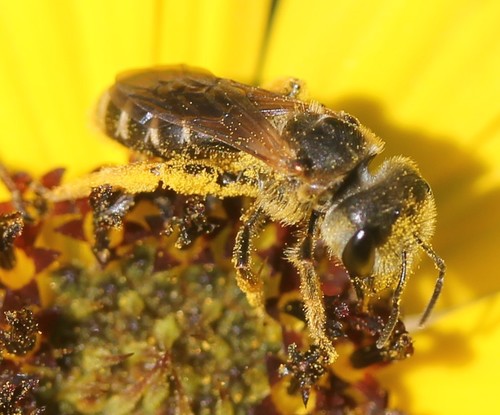


Poey'S Furrow Bee
halictus poeyi
Poey's Furrow Bee (Halictus poeyi) is a fascinating species of sweat bee closely related to the widespread Ligated Furrow Bee. Found primarily in the southeastern United States, this hardworking insect plays a vital role in local ecosystems by pollinating a vast array of wildflowers and agricultural crops. What makes H. poeyi particularly interesting is its complex social structure; these bees are primitively eusocial, meaning they form small underground colonies governed by a reproductive queen and supported by her non-reproductive worker daughters. Often overlooked due to their small stature, these bees are incredibly industrious. They earn their "furrow bee" moniker from the extensive, branching tunnels they excavate in bare, well-drained soil. Furthermore, they are famously known as "sweat bees" because of their curious habit of landing on humans to lap up perspiration, a behavior driven by their need to supplement their diet with essential salts and moisture that are often lacking in floral nectar.
Habitat: Found in open, sunny environments such as meadows, prairies, agricultural fields, and urban gardens where patches of bare soil are available for nesting.
Poey's Furrow Bee is a small to medium-sized insect, typically measuring between 7 and 11 millimeters in length. It features a dark brownish-black to slightly metallic head and thorax, with a robust, heavily punctate (pitted) exoskeleton. A key identifying feature is the presence of distinct pale, whitish or yellowish hair bands located on the apical (trailing) edges of its abdominal segments. Females possess dense brushes of specialized hairs (scopae) on their hind legs, which are often packed with bright yellow or orange pollen. Males are generally more slender, have much longer antennae, and display conspicuous yellow markings on their legs and lower faces.
Category
InsectsRarity
Common
Danger
1/5 · Very low
Snaps
Be the first to snap!
As a 'sweat bee', it has a mild sting that is virtually painless to humans, usually only stinging if it becomes accidentally trapped or squished against the skin.
For a long time, Poey's Furrow Bee was thought to be exactly the same species as the Ligated Furrow Bee (Halictus ligatus) until scientists noticed subtle differences in their genetics and wing shapes.
To survive the winter, only the newly mated queens hibernate underground, emerging in the spring to start entirely new colonies from scratch.
Forms underground colonies with a reproductive queen and female workers, representing a key evolutionary stepping stone between solitary and fully social bees.
Actively seeks out and laps up human or animal sweat to obtain essential minerals and moisture that are scarce in a strict nectar diet.
Digs deep, branching architectural tunnels in hard-packed dirt to create highly protected nursery chambers for their developing brood.
Adults consume nectar for energy and gather pollen to provision their underground brood cells for the developing larvae.
Age differences: Larvae feed exclusively on pollen and nectar provisions left in their cell by the mother or workers; adult bees primarily consume nectar for energy.

Bidens alba
Poey's Furrow Bee is a major pollinator for this common, prolific southeastern wildflower.

Misumena vatia
Crab spiders camouflage themselves on flower heads to ambush and consume foraging sweat bees.
Sphecodes spp.
Cleptoparasitic cuckoo bees sneak into the furrow bee's nest to lay their own eggs on the hard-earned pollen provisions.
No trait badges are assigned for this object yet.
No aliases listed yet.
Collections for this object will appear here as more themes are added.
Danger
1/5 · Very low
No special safety notes yet.
Compare the antennae, wings, waist, body hair and legs. Yellow and black stripes show up on bees, wasps and harmless mimics alike. Bee & Wasp Identifier: upload a photo and compare the visible details.
0-1 cm
1 cm
0.00002-0.00005 kg
0-1 years
15 km/h
Adults consume nectar for energy and gather pollen to provision their underground brood cells for the developing larvae.
Found in open, sunny environments such as meadows, prairies, agricultural fields, and urban gardens where patches of bare soil are available for nesting.
Zoom in to split clusters and explore where this object has been snapped.
Recent snaps will appear here as new observations are added.

Florida, US
You might spot Atala, Monarch, and Brown Anole.
View guide →

Florida, US
You might spot Brown Anole, Monarch, and Eastern Lubber Grasshopper.
View guide →

South Carolina, US
You might spot Gulf Fritillary, Poey's Furrow Bee, and Anole.
View guide →
Take the discovery with you
Snap it with Snappit to identify it, learn what makes it special, and add the discovery to your collection.