

Prettyface
triteleia ixioides
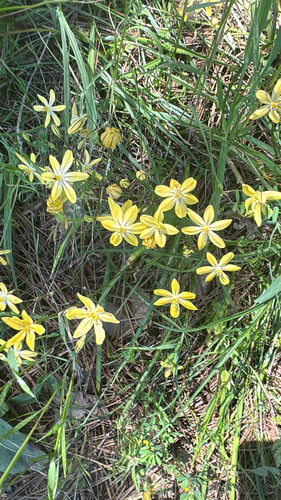
Prettyface (Triteleia ixioides) is a captivating herbaceous perennial wildflower native to the diverse landscapes of California and southwest Oregon. Rising from underground fibrous-coated corms, this resilient member of the asparagus family graces coniferous forests, foothills, and grassy slopes with bursts of bright color during late spring and summer. Its striking golden-yellow floral displays arranged in umbrella-like clusters make it a true jewel of the chaparral and montane plant communities. This plant holds a significant place in both ecological networks and ethnobotanical history. Native American tribes historically harvested its nutritious, starch-rich corms as a valuable food source, usually roasting or boiling them to yield a sweet, potato-like flavor. Today, Prettyface is celebrated not only for its rugged beauty and drought tolerance but also for its ecological role as an important nectar provider for native bees, butterflies, and other beneficial insect pollinators in western North American ecosystems.
Habitat: Found in open coniferous forests, oak woodlands, meadows, and foothill chaparral, typically thriving in well-drained, sandy, or gravelly soils.
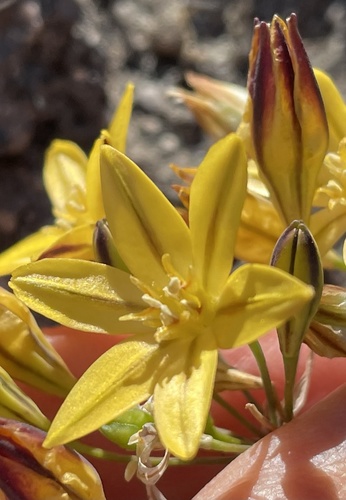
Prettyface is easily recognized by its loose, umbrella-like flower clusters (umbels) containing up to 50 star-shaped flowers sitting atop a single, slender, leafless stem measuring 10 to 80 centimeters tall. The flowers range from pale straw-yellow to deep golden-yellow, with each of the six tepals prominently marked by a dark green, brown, or purple midvein running down the center. Its long, grass-like leaves emerge from the base of the plant, often drying up by the time the blossoms fully open. The stamens inside the flower are arranged in two distinct rows, with yellow or blue anthers adding to its colorful, intricate design.
Category
PlantsRarity
Common
Danger
1/5 · Very low
Snaps
2
Its common name 'Prettyface' is derived from the exceptionally charming appearance of its delicate, star-shaped yellow blossoms.
The flowers feature a distinctive dark midvein on each of the six tepals, which functions as a nectar guide to direct visiting insect pollinators.
The underground bulbs, or corms, of Prettyface were historically harvested and eaten by Native Californian tribes, who roasted or boiled them like potatoes.
Survives dry, hot summer months by storing water and energy in an underground, fibrous-coated corm, remaining dormant until autumn rains return.
Utilizes deep underground corms to survive passing wildfires, quickly resprouting in the nutrient-rich, cleared soils left in the fire's aftermath.
Features highly visible dark midveins on its petals that act as precise visual pathways, directing pollinators to its nectar reserves.
As a photoautotrophic plant, Prettyface synthesizes its own sugars using sunlight, water, and carbon dioxide through photosynthesis, supplemented by soil minerals.
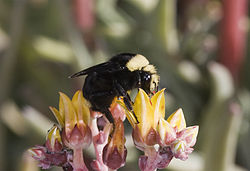
Bombus vosnesenskii
Provides crucial nectar and pollen to native bumblebees during the late spring flight season.

Thomomys bottae
The underground, starch-rich corms are dug up and eaten as a primary food source.

Odocoileus hemionus
Foliage and developing buds are occasionally grazed by deer.
No trait badges are assigned for this object yet.
No aliases listed yet.
Collections for this object will appear here as more themes are added.
Danger
1/5 · Very low
No special safety notes yet.
Start with the whole plant, then compare leaf arrangement, leaf edges, stems and any flowers or fruit. Opposite leaves grow in pairs; alternate leaves come one at a time along the stem. These details tell you far more together than a single green leaf does. Plant Identifier: upload a photo and compare the visible details.
10-80 cm
0.01-0.05 kg
3-10 years
As a photoautotrophic plant, Prettyface synthesizes its own sugars using sunlight, water, and carbon dioxide through photosynthesis, supplemented by soil minerals.
Found in open coniferous forests, oak woodlands, meadows, and foothill chaparral, typically thriving in well-drained, sandy, or gravelly soils.
Zoom in to split clusters and explore where this object has been snapped.

California, US
You might spot White Globe Lily, Rose Campion, and Pipevine Swallowtail.
View guide →
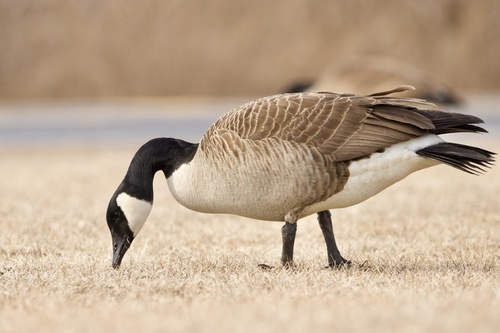
Nevada, US
You might spot Canada Goose, Antelope Bitterbrush, and Steller's Jay.
View guide →
Take the discovery with you
Snap it with Snappit to identify it, learn what makes it special, and add the discovery to your collection.