_Geranium_robertianum_-_blossom_and_bud.jpg&width=800)





Herb Robert
Geranium robertianum
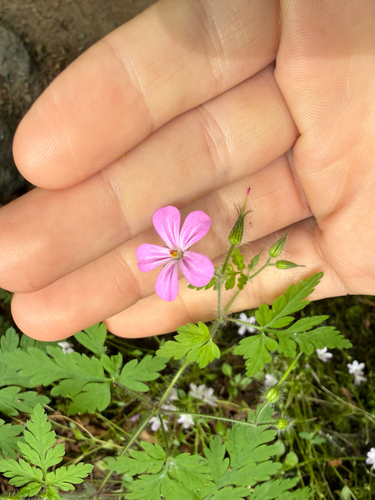
Herb Robert is a small, pretty plant with bright green leaves and pink flowers. It often grows in shady places and is loved by many little creatures in nature.
Habitat: Forests
The Herb Robert has delicate, deeply cut fern-like leaves and often reddish stems and foliage, especially in sunlight or cold. Its small, five-petaled flowers are a vibrant pinkish-purple, making it stand out from similar green plants.
Category
PlantsRarity
Common
Danger
1/5 · Very low
Snaps
26
In folklore, Herb Robert was sometimes believed to bring good luck!
Its stem and leaves often turn bright red in sunshine or cold weather!
Its tiny seeds can launch themselves like mini rockets!
Some people call this plant 'Stinky Bob' for its strong smell!
Herb Robert has a strong, musky odor when crushed that helps it defend against hungry animals trying to eat its leaves.
Herb Robert can launch its seeds with tiny explosive pods, flinging them away from the parent plant to reproduce.
Herb Robert has leaves that turn reddish in bright sun or cold, using special pigments to protect itself from stress.
Apis mellifera
Gathers nectar and pollen from flowers
Bombus terrestris
Visits flowers for nectar and pollen

Helix aspersa
Feeds on the leaves and stems
Aromatic plants produce and emit fragrant volatile organic compounds, often for defense or to attract pollinators.
Flowering plants are any plants that produce flowers as part of their reproductive cycle.
Shade tolerant plants are adapted to grow and thrive in areas with low light levels, requiring less direct sunlight.
Fragrant flowers emit a pleasant aroma, often to attract pollinators or for defense.

Medicinal plants possess chemical compounds that can be used for therapeutic purposes to treat illnesses or maintain health.

Edible plants are those parts of a plant that are considered safe for human consumption.

Describes plants that are particularly attractive and beneficial to a wide range of pollinating organisms.

Rapid growing plants exhibit accelerated growth rates, quickly increasing in size and biomass within a short period.

This human use trait indicates species from which spices are derived, used for flavoring, preserving food, or as aromatic agents.

Forest habitats are terrestrial environments dominated by dense tree cover, supporting a high diversity of plant and animal life.
Danger
1/5 · Very low
Always look but don't touch plants unless you know they are safe.
The easiest way to identify Herb Robert is to use the Snappit nature identifier app.
15-50 cm
15-50 cm
1-2 cm
Spring to fall
Yes
None
Biennial
Zoom in to split clusters and explore where this object has been snapped.
Jun 4, 2026
Glines Canyon DamPhoto attribution
(c) Max Miley, some rights reserved (CC BY)
License: CC BY 4.0 ↗
Image may be shown cropped inside the card frame.

Massachusetts, US
You might spot Maidenhair Spleenwort and Red Trillium.
View guide →

Massachusetts, US
You might spot Eastern Newt, Purple Pitcher Plant, and Hobblebush.
View guide →

New York, US
You might spot American Toad and Intermediate Wood Fern.
View guide →

Vermont, US
You might spot Eastern White Pine, Staghorn Sumac, and Box Elder.
View guide →

Ohio, US
You might spot Duck, Canada Goose, and Muscovy Duck.
View guide →

Connecticut, US
You might spot Osprey, Diamondback Terrapin, and Monarch.
View guide →
Take the discovery with you
Snap it with Snappit to identify it, learn what makes it special, and add the discovery to your collection.







.jpg&width=800)


_001.jpg&width=800)


