





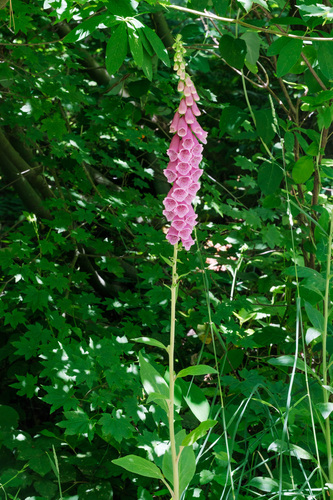
purple foxglove
Digitalis purpurea
The purple foxglove is a tall, beautiful flower that can grow up to six feet high! Its lovely purple blooms attract bees and butterflies, making gardens colorful and lively.
Habitat: Woodlands
The purple foxglove has tall, striking spires of bell-shaped, deep purple flowers, often with dark spots and white edges inside. Its distinctive, drooping blossoms grow densely on one side of the stem, making it stand out from other wildflowers.
Category
PlantsRarity
Common
Danger
3/5 · Moderate
Snaps
39
Wow! Its tall flower stalk can grow up to a grown-up's height in just one summer!
Wow! Old stories say fairies used its bell flowers as tiny gloves!
Wow! Only big fuzzy bees, like bumblebees, can fit inside its special flowers!
Wow! The plant helps doctors make important medicine for people's hearts!
Purple foxglove has speckled patterns inside its flowers that guide buzzing bees directly to its sweet nectar.
Purple foxglove produces powerful chemicals, called cardiac glycosides, that protect it from hungry animals.
Purple foxglove can produce thousands of tiny, dust-like seeds, helping it spread far and wide.
Bombus terrestris
collects nectar and pollen from flowers.
Apis mellifera
gathers nectar from its tubular flowers.

Homo sapiens
uses its compounds for heart medication.
Bell-shaped flowers possess petals fused or arranged to form a cup-like or campanulate structure resembling a bell.
Flowering plants are any plants that produce flowers as part of their reproductive cycle.
Biennial plants complete their life cycle over two growing seasons, typically forming foliage in the first year and flowering/seeding in the second.
Fragrant flowers emit a pleasant aroma, often to attract pollinators or for defense.

Medicinal plants possess chemical compounds that can be used for therapeutic purposes to treat illnesses or maintain health.

Colorful describes organisms or objects displaying a wide range of bright and distinct colors.

Describes plants that are particularly attractive and beneficial to a wide range of pollinating organisms.

Forest habitats are terrestrial environments dominated by dense tree cover, supporting a high diversity of plant and animal life.
No aliases listed yet.
Danger
3/5 · Moderate
Don't touch the flowers or leaves, as they can be harmful if eaten.
The easiest way to identify purple foxglove is to use the Snappit nature identifier app.
60-180 cm
30-60 cm
4-6 cm
Late spring to mid-summer
No
Deadly
Biennial
Zoom in to split clusters and explore where this object has been snapped.
May 28, 2026
Hoyt ArboretumPhoto attribution
no rights reserved
License: CC0 1.0 ↗
Image may be shown cropped inside the card frame.

California, US
You might spot Redwood Sorrel, Redwood, and Button's Banana Slug.
View guide →

California, US
You might spot Redwood, Pacific Trillium, and Evergreen Huckleberry.
View guide →

Oregon, US
You might spot Duck, Pacific Trillium, and Wood Duck.
View guide →

Washington, US
You might spot Pacific Tree Frog and Long-Toed Salamander.
View guide →

Wisconsin, US
You might spot Turkey, White-Tailed Deer, and Dame's Rocket.
View guide →

Washington, US
You might spot Pacific Banana Slug and Oregon Forestsnail.
View guide →
Take the discovery with you
Snap it with Snappit to identify it, learn what makes it special, and add the discovery to your collection.







.jpg&width=800)


_001.jpg&width=800)




