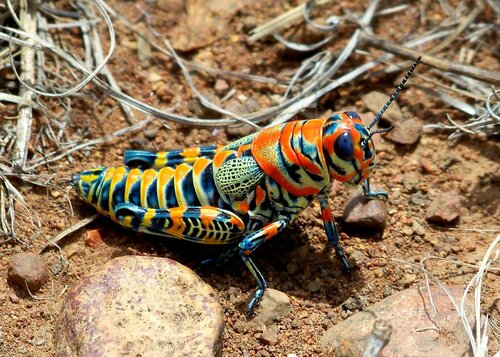


Rainbow Grasshopper
dactylotum bicolor
The Rainbow Grasshopper is one of North America's most dazzling insects, renowned for its brilliant, multi-colored exoskeleton. Resembling a meticulously hand-painted toy, this small grasshopper displays a striking mosaic of red, orange, yellow, blue, and black markings. Unlike many of its drab green or brown relatives, this species uses its vibrant appearance as a visual warning to potential predators rather than a tool for camouflage, making it highly conspicuous. It is a beloved sight for nature enthusiasts exploring the arid grasslands, shortgrass prairies, and desert scrublands of the Great Plains and Chihuahuan Desert. Because they are mostly flightless, they can often be observed slowly walking or jumping among low-growing vegetation, showcasing their brilliant patterns up close.
Habitat: Found in dry shortgrass prairies, desert shrublands, and rocky hillsides across western North America.
This species is instantly recognizable by its bold, non-overlapping bands of reddish-orange, bright yellow, and deep black or dark blue. The base color is typically black to dark olive green, with vibrant yellow and red stripes running along its pronotum and abdomen. They are relatively small, measuring between 2 to 4 centimeters in length. Due to their flightless nature, their wings are reduced to tiny, non-functional oval pads that do not cover the abdomen.
Category
InsectsRarity
Common
Danger
1/5 · Very low
Snaps
5
Their bright coloration is a form of aposematism, warning predators of their foul taste, which they acquire by eating toxic plants like snakeweed.
They are also known as the painted grasshopper because their vibrant markings look like they were carefully applied by hand.
Unlike most grasshoppers, the Rainbow Grasshopper cannot fly because its wings are reduced to tiny, non-functional pads.
Utilizes its bright, high-contrast coloration to warn predators of its foul taste and potential toxicity.
Safely consumes and stores toxic compounds from host plants, making itself unpalatable to birds and lizards.
Uses strong hind legs to make quick, erratic leaps through dense ground vegetation to evade threats since it cannot fly.
Feeds primarily on a variety of low-growing desert herbs, wildflowers, and native grasses, often targeting toxic host plants.
Age differences: Nymphs feed on soft, tender shoots of young plants, while mature adults consume tougher, more fibrous vegetation.
No trait badges are assigned for this object yet.
No aliases listed yet.
Collections for this object will appear here as more themes are added.
Danger
1/5 · Very low
No special safety notes yet.
The easiest way to identify Rainbow Grasshopper is to use the Snappit nature identifier app.
2+ cm
0.001+ kg
1+ years
5 km/h
Feeds primarily on a variety of low-growing desert herbs, wildflowers, and native grasses, often targeting toxic host plants.
Found in dry shortgrass prairies, desert shrublands, and rocky hillsides across western North America.
Grazing
Zoom in to split clusters and explore where this object has been snapped.

New Mexico, US
You might spot Pronghorn, Great-Tailed Grackle, and Redstem Stork's-Bill.
View guide →

Texas, US
You might spot Grooved Nipple Cactus and Blanchard's Cricket Frog.
View guide →

Kansas, US
You might spot Cliff Swallow and Desert Prince's Plume.
View guide →

New Mexico, US
You might spot Sunflower, Sideoats Grama, and Tree Cholla.
View guide →
Take the discovery with you
Snap it with Snappit to identify it, learn what makes it special, and add the discovery to your collection.














.jpg&width=800)




