
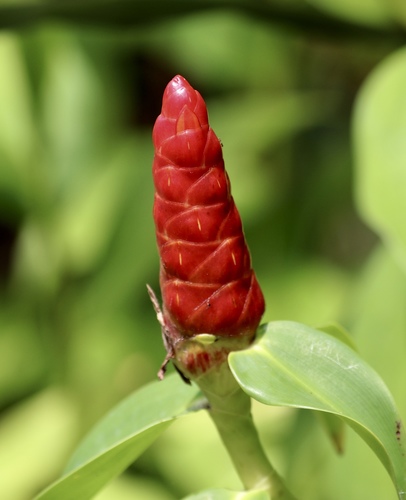


Red Button Ginger
costus woodsonii
Red Button Ginger (Costus woodsonii) is a striking tropical perennial celebrated for its vibrant inflorescences and lush foliage. This member of the ginger family, though not a 'true' ginger, captivates with its distinctive 'button' flower structures. It's highly cherished in tropical gardens and as a houseplant for its ornamental appeal, providing a splash of color and exotic texture. Beyond its beauty, it plays a role in its native ecosystem by attracting specific pollinators and contributing to the rich biodiversity of the forest understory. Its unique growth habit and continuous flowering make it a fascinating subject for both botanists and garden enthusiasts.
Habitat: Red Button Ginger thrives in the moist, shaded understory of tropical and subtropical rainforests and cloud forests, often found near streams or in damp ravines.
This plant is characterized by its erect, spiraling stems, which typically reach 1 to 2 meters in height, adorned with glossy, dark green leaves arranged alternately. The most prominent feature is its cone-like inflorescence, usually bright red or orange, resembling a button or pinecone, from which individual yellow or orange tubular flowers emerge. These delicate flowers often possess a frilly or ruffled margin, creating a beautiful contrast against the vivid red bracts.
Category
PlantsRarity
Common
Danger
1/5 · Very low
Snaps
Be the first to snap!
Despite its common name, Red Button Ginger is not a 'true ginger' (family Zingiberaceae) but belongs to its own distinct family, Costaceae, which can be distinguished by its spiraling stems.
It is often mistaken for some Heliconia species due to its similar showy inflorescence, though their growth habits and botanical structures differ significantly upon closer inspection.
The unique spiral arrangement of its leaves and stems is an adaptation that helps maximize light absorption, a crucial advantage for plants growing in the shaded understory of dense forests.
The vibrant red 'button' structure is actually a bract, a modified leaf that protects the true, smaller, delicate flowers that emerge from within it.
The stems of Costus woodsonii exhibit a distinctive spiral growth pattern, a characteristic feature of many species within the Costaceae family, which helps optimize light capture in dense understory environments.
In ideal conditions, this plant produces its vibrant, cone-like inflorescences almost continuously throughout the year, ensuring a steady attraction for its primary pollinators.
Its showy red bracts cleverly conceal small, nectar-rich tubular yellow or orange flowers, specifically adapted to attract and reward hummingbirds and various insects for their pollination services.
As a photosynthetic plant, Red Button Ginger produces its own food through the process of photosynthesis, utilizing sunlight, carbon dioxide, and water. It absorbs essential nutrients and minerals from the soil through its root system.

Archilochus colubris
Primary pollinator for its nectar-rich flowers.
Euglossa dilemma
Important insect pollinator, attracted to the flowers.

Glomeromycota
Symbiotic association with roots, enhancing nutrient uptake.
Insecta
Certain insect larvae may feed on its leaves.
No trait badges are assigned for this object yet.
No aliases listed yet.
Collections for this object will appear here as more themes are added.
Danger
1/5 · Very low
No special safety notes yet.
Start with the whole plant, then compare leaf arrangement, leaf edges, stems and any flowers or fruit. Opposite leaves grow in pairs; alternate leaves come one at a time along the stem. These details tell you far more together than a single green leaf does. Plant Identifier: upload a photo and compare the visible details.
100-200 cm
3-10 years
As a photosynthetic plant, Red Button Ginger produces its own food through the process of photosynthesis, utilizing sunlight, carbon dioxide, and water. It absorbs essential nutrients and minerals from the soil through its root system.
Red Button Ginger thrives in the moist, shaded understory of tropical and subtropical rainforests and cloud forests, often found near streams or in damp ravines.
Photosynthesis/nutrient Absorption
Zoom in to split clusters and explore where this object has been snapped.
Recent snaps will appear here as new observations are added.
Take the discovery with you
Snap it with Snappit to identify it, learn what makes it special, and add the discovery to your collection.


















