

Red Mount Teide Bugloss
echium wildpretii
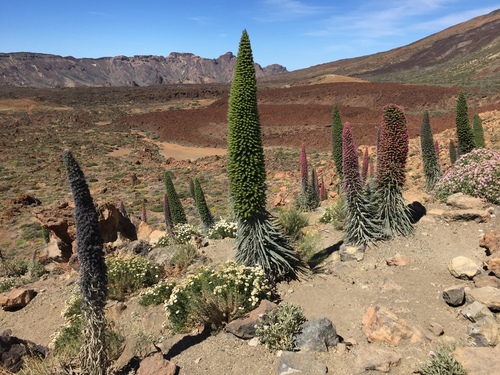
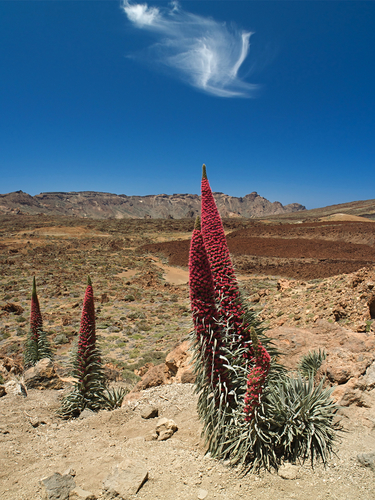
The Red Mount Teide Bugloss, scientifically known as Echium wildpretii, is one of the most spectacular botanical wonders of the Canary Islands. Endemic to the high-altitude, volcanic slopes of Mount Teide on Tenerife, this extraordinary plant is famous for its towering, spike-like silhouette that rises dramatically against the stark, lunar landscape. Commonly referred to as 'Tajinaste Rojo' by locals, it has adapted beautifully to the harsh, sun-baked, and freezing conditions of its subalpine habitat. As a monocarpic biennial, it spends its initial years as a humble rosette of silvery leaves, storing energy for a single, magnificent reproductive event. When the time comes in late spring, it shoots upward, producing a colossal flowering column covered in thousands of vibrant red blossoms. This short-lived but breathtaking show transforms the volcanic caldera into a sea of color, drawing pollinators and nature enthusiasts from around the world before the plant finally completes its life cycle and perishes.
Habitat: Found exclusively in the arid, high-altitude subalpine volcanic zones of Mount Teide on Tenerife, growing on steep, rocky slopes and basalt gravel.
This plant is instantly recognizable by its monumental, spear-like inflorescence which can reach heights of up to 300 centimeters. In its vegetative stage, it forms a dense, ground-hugging rosette of narrow, lance-shaped leaves that are covered in soft, silvery-gray hairs, giving them a frosted appearance. During late spring, the massive, conical flower spike emerges, densely packed with thousands of small, funnel-shaped flowers of an intense, coral-red to crimson hue that contrast sharply with the dark volcanic terrain.
Category
PlantsRarity
Common
Danger
1/5 · Very low
Snaps
Be the first to snap!
A single giant flower spike can contain up to 80,000 individual, nectar-rich flowers blooming concurrently.
After blooming and shedding its seeds, the entire majestic red column dries up and turns into a ghostly silver-grey skeleton.
Locals refer to this spectacular plant as 'Tajinaste Rojo', a name derived from the Guanche language.
It channels all its stored lifetime energy into a single, massive flowering event to produce thousands of seeds, maximizing reproduction rates before dying.
Dense, silver-gray hairs on the leaves trap warmth and reflect intense alpine solar radiation while protecting the plant from freezing night temperatures.
Its deep taproot system anchors securely in loose scree and extracts scarce moisture from deep within porous volcanic soils.
As a photosynthetic plant, it manufactures its own nutrients using sunlight, water, carbon dioxide, and essential minerals absorbed from volcanic soil.
Bombus canariensis
The endemic Canary Island bumblebee is a major pollinator, attracted to the thousands of nectar-rich red blossoms.
Gallotia galloti
Lizards scale the towering stems to consume nectar and assist in pollination and opportunistic seed dispersal.

Oryctolagus cuniculus
Introduced European rabbits forage on the tender young rosettes, threatening young plants before they can bloom.
No trait badges are assigned for this object yet.
No aliases listed yet.
Collections for this object will appear here as more themes are added.
Danger
1/5 · Very low
No special safety notes yet.
Start with the whole plant, then compare leaf arrangement, leaf edges, stems and any flowers or fruit. Opposite leaves grow in pairs; alternate leaves come one at a time along the stem. These details tell you far more together than a single green leaf does. Plant Identifier: upload a photo and compare the visible details.
100-300 cm
2-3 years
As a photosynthetic plant, it manufactures its own nutrients using sunlight, water, carbon dioxide, and essential minerals absorbed from volcanic soil.
Found exclusively in the arid, high-altitude subalpine volcanic zones of Mount Teide on Tenerife, growing on steep, rocky slopes and basalt gravel.
Zoom in to split clusters and explore where this object has been snapped.
Recent snaps will appear here as new observations are added.
Take the discovery with you
Snap it with Snappit to identify it, learn what makes it special, and add the discovery to your collection.