


Red Spruce
picea rubens
The Red Spruce (Picea rubens) is a majestic, long-lived evergreen conifer native to eastern North America. Renowned for its elegant, narrow pyramidal shape and shiny yellow-green foliage, it characterizes the high-elevation forests of the Appalachian Mountains and the misty Acadian woods. This resilient tree plays an irreplaceable role in its native ecosystems, offering crucial shelter and nesting sites for montane bird species and mammals. Historically, the exceptionally resonant wood of the Red Spruce has been highly prized for crafting high-quality acoustic instruments, such as violins and guitars.
Habitat: Found in cool, moist, and well-drained soils of high-elevation montane forests and damp northern valleys.
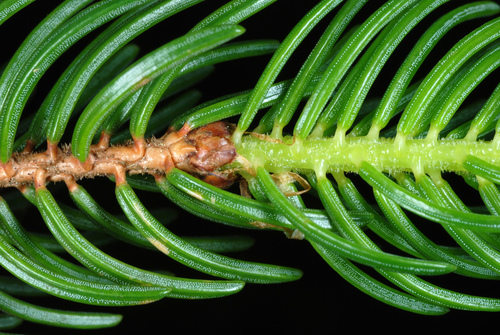
The Red Spruce is a medium to large evergreen conifer typically growing 18 to 30 meters tall, characterized by a narrow, conical crown. Its sharp, four-sided needles are shiny yellow-green, about 12 to 15 millimeters long, and grow singly pointing outward from all sides of the yellowish twigs. The bark is thick and grayish-brown on the surface, but reveals a distinct reddish-brown interior when scaled or broken. It produces small, dangling cylindrical cones that measure 3 to 5 centimeters in length, maturing to a glossy reddish-brown color with smooth, rounded scales.
Category
PlantsRarity
Common
Danger
1/5 · Very low
Snaps
Be the first to snap!
Because of its superb sound-conducting properties, Red Spruce is considered the gold standard for acoustic guitar soundboards.
Its needles are rich in vitamin C and can be brewed into a refreshing herbal tea or used to flavor traditional spruce beer.
The sticky, aromatic resin of the Red Spruce was harvested in the 19th century to produce the very first commercial chewing gums in the United States.
The wood of the Red Spruce has a high stiffness-to-weight ratio, allowing it to transmit sound waves exceptionally well, which makes it a preferred material for musical instruments.
This species adapts to freezing temperatures by modifying its cellular membranes to prevent the formation of destructive ice crystals within its living tissues.
Dropped spruce needles decompose slowly and release organic acids, creating an acidic soil layer that inhibits competing hardwood species from germinating nearby.
As a photoautotrophic organism, the Red Spruce manufactures its own food using sunlight, carbon dioxide, and water through the process of photosynthesis.

Tamiasciurus hudsonicus
Feeds on the seeds extracted from mature cones.
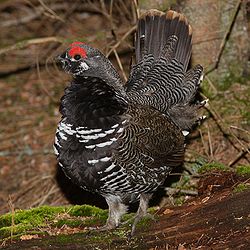
Falcipennis canadensis
Consumes the needles and buds as a primary winter food source.
Choristoneura fumiferana
Feeds on the fresh spring foliage and can cause severe defoliation during outbreaks.
No trait badges are assigned for this object yet.
No aliases listed yet.
Collections for this object will appear here as more themes are added.
Danger
1/5 · Very low
No special safety notes yet.
Start with the whole plant, then compare leaf arrangement, leaf edges, stems and any flowers or fruit. Opposite leaves grow in pairs; alternate leaves come one at a time along the stem. These details tell you far more together than a single green leaf does. Plant Identifier: upload a photo and compare the visible details.
1800-3500 cm
250-400 years
As a photoautotrophic organism, the Red Spruce manufactures its own food using sunlight, carbon dioxide, and water through the process of photosynthesis.
Found in cool, moist, and well-drained soils of high-elevation montane forests and damp northern valleys.
Zoom in to split clusters and explore where this object has been snapped.
Recent snaps will appear here as new observations are added.

West Virginia, US
You might spot Eastern Red-Backed Salamander and Wehrle's Salamander.
View guide →

Québec, CA
You might spot Canada Jay, Bluebead Lily, and Hobblebush.
View guide →
Take the discovery with you
Snap it with Snappit to identify it, learn what makes it special, and add the discovery to your collection.

















