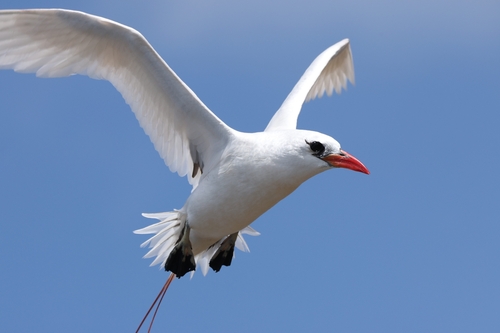


Red-Tailed Tropicbird
phaethon rubricauda
The Red-tailed Tropicbird, often considered one of the most striking seabirds, is a true master of the open ocean. Characterized by its brilliant white plumage and long, crimson tail streamers, this species spends the majority of its life soaring over the warm, tropical waters of the Indian and Pacific Oceans. Rather than relying on land, they only come ashore to breed, selecting remote oceanic islands and atolls to raise their young. Watching a Red-tailed Tropicbird in flight is a mesmerizing experience. They perform breathtaking, acrobatic aerial courtship displays, flying in synchronized circles while calling out to mates. Despite their aerial agility and prowess in plunge-diving for fish, they are incredibly awkward on land. Their legs are positioned so far back on their bodies that they cannot walk properly, instead awkwardly shuffling forward on their bellies to reach their nests.
Habitat: Exclusively marine and pelagic, they spend most of their lives over warm tropical oceanic waters, coming ashore only to nest on remote coral atolls and volcanic islands.
The Red-tailed Tropicbird is a medium-sized seabird primarily boasting bright white plumage that contrasts sharply with a black crescent-shaped mask extending through the eyes. Its most distinct feature is a pair of extremely elongated, thin, bright red central tail feathers, known as streamers, which can double the bird's overall length. They have a stout, bright red beak suited for catching fish, and subtle black shafts visible on their primary flight feathers. With a wingspan reaching up to 120 cm, they have a robust, somewhat chunky body shape in flight, setting them apart from other slender seabirds.
Category
BirdsRarity
Common
Danger
1/5 · Very low
Snaps
Be the first to snap!
Because they lack a brood patch, they use their webbed feet, which are heavily supplied with blood vessels, to keep their single egg warm during incubation.
In Polynesian culture, the vibrant red tail feathers of this bird were highly prized and historically used for personal adornment and trade.
The red tail streamers of a Red-tailed Tropicbird can take up to 35 centimeters of their total body length.
They are known to fly hundreds of miles away from land and can remain at sea for months without ever touching solid ground.
They can hover briefly 15 to 30 meters above the water before folding their wings and diving like a missile into the ocean to catch fish and squid.
Because their legs are positioned extremely far back on their bodies to aid in swimming, they cannot walk on two legs and must awkwardly push themselves forward on their bellies on land.
During mating season, they perform spectacular, synchronized aerial displays, involving high-speed chases, backward flight, and intricate vertical circles in the sky.
The Red-tailed Tropicbird is a marine predator that feeds heavily on fish and cephalopods caught near the ocean's surface.
Age differences: Chicks are fed regurgitated, partially digested fish and squid until they fledge.
Exocoetus volitans
Primary prey species targeted during plunge-dives.
Fregata minor
Often steals caught food from tropicbirds in mid-air via kleptoparasitism.

Rattus rattus
Invasive predator that attacks ground nests and eats chicks.
No trait badges are assigned for this object yet.
No aliases listed yet.
Collections for this object will appear here as more themes are added.
Danger
1/5 · Very low
No special safety notes yet.
Compare the silhouette, bill shape, tail length, wing bars and markings around the eyes. The same small brown bird at your feeder can look quite different in breeding plumage, winter plumage or its first year. Bird Identifier: upload a photo and compare the visible details.
90-105 cm
100-120 cm
0.6-0.85 kg
15-20 years
45 km/h
The Red-tailed Tropicbird is a marine predator that feeds heavily on fish and cephalopods caught near the ocean's surface.
Exclusively marine and pelagic, they spend most of their lives over warm tropical oceanic waters, coming ashore only to nest on remote coral atolls and volcanic islands.
Zoom in to split clusters and explore where this object has been snapped.
Recent snaps will appear here as new observations are added.
Take the discovery with you
Snap it with Snappit to identify it, learn what makes it special, and add the discovery to your collection.